Advertisement
CS Lee Kinyanjui hails Moody’s upgrade, cites stronger reserves and growth prospects
Thursday 29th January, 2026 11:53 AM|

Cabinet Secretary for Investments, Trade and Industry Lee Kinyanjui has welcomed Moody’s Ratings’ recent upgrade of Kenya’s sovereign credit ratings, terming it an important boost to the country’s economic outlook and investment environment.
He said the decision reflects improving fundamentals and growing confidence in Kenya’s ability to manage its short-term obligations and financing needs.
In a post on X dated January 29, 2026, Kinyanjui said the upgrade was a positive signal for the economy.
“We are delighted to note the upward revision of Kenya’s outlook from positive to stable by Moody’s,” he stated.
You Might Also Like


He noted that the agency had recognised Kenya’s improved position in meeting short-term debt obligations, attributing it to higher foreign-exchange reserves, a more stable shilling, and a narrower gap between imports and exports.
“The government is also finding it easier to raise financing locally, reducing reliance on external borrowing,” Kinyanjui added.
Moody’s upgrades Kenya to B3
On January 27, 2026, in New York, Moody’s Ratings upgraded the Government of Kenya’s local and foreign currency long-term issuer ratings, as well as its foreign currency senior unsecured debt ratings, to B3 from Caa1.
The agency also revised the outlook to stable from positive. Moody’s said the upgrade reflects a reduction in Kenya’s near-term default risk, supported by stronger external liquidity.
“External liquidity has strengthened, reflected in higher foreign-exchange reserves, a narrower current account deficit, and a more stable exchange rate,” the agency stated.
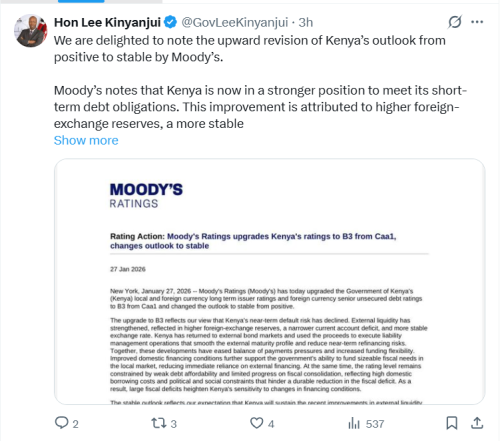
It added that Kenya’s return to external bond markets and the use of proceeds for liability management operations have helped smooth the external maturity profile and reduce near-term refinancing risks. These developments have eased balance of payments pressures and increased funding flexibility.
Moody’s also noted that improved domestic financing conditions have enabled the government to meet sizeable fiscal needs in the local market, reducing immediate reliance on external borrowing.
At the same time, the agency cautioned that the rating remains constrained by weak debt affordability and limited progress on fiscal consolidation, citing high domestic borrowing costs and social and political constraints.
Large fiscal deficits, it said, continue to heighten sensitivity to changes in financing conditions. The stable outlook reflects expectations that recent improvements in external liquidity will be sustained.
Implications for financing and growth
Kinyanjui said the upgrade carries broader implications beyond government borrowing, adding that the improved rating enhances access to funding while lowering borrowing costs, creating opportunities for both the public and private sectors.
“With the improved rating, access to funding is enhanced while borrowing costs are reduced, creating greater growth opportunities for both the private and public sectors,” he noted.
Kinyanjui said sustaining the gains would require sound macroeconomic policies and continued fiscal discipline, adding that the development is expected to support investor confidence and attract increased foreign direct investment.
Author
Latest News








Advertisement
More on Business