Advertisement
Counties’ revenue share talks begin as Senate pushes for Ksh454.7B allocation
Friday 05th June, 2026 02:30 PM|
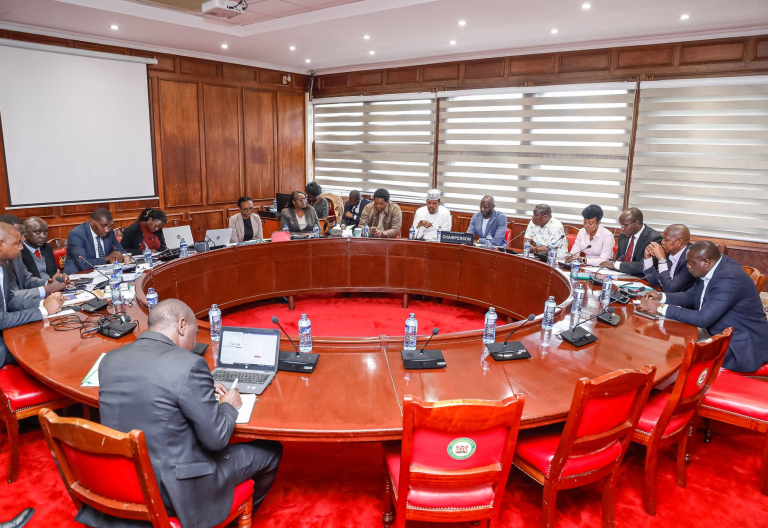
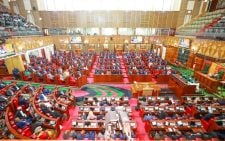
A mediation process has commenced in Parliament to resolve a standoff between the National Assembly and the Senate over the equitable share of revenue allocated to county governments in the Division of Revenue Bill, 2026.
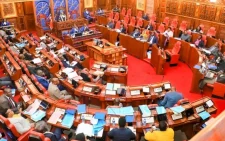
The dispute centres on the Senate’s proposal to increase county allocations to Ksh454.7 billion, up from the Ksh420 billion approved by the National Assembly. The mediation committee is expected to negotiate a consensus position to allow implementation of the 2026/27 budget.
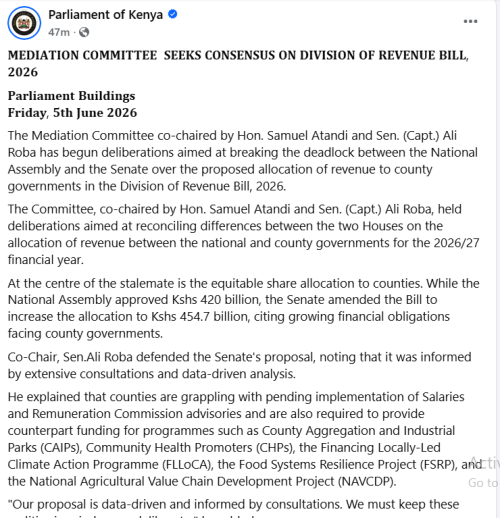
“The Mediation Committee, co-chaired by Hon. Samuel Atandi and Sen. (Capt.) Ali Roba has begun deliberations aimed at breaking the deadlock between the National Assembly and the Senate over the proposed allocation of revenue to county governments in the Division of Revenue Bill, 2026,” read the post in part.
Senate defends higher county allocation
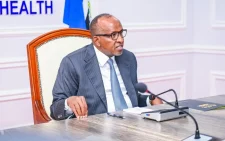
The Mediation Committee is co-chaired by Budget and Appropriations Committee Chair Samuel Atandi and Senate Majority Leader Ali Roba.
You Might Also Like
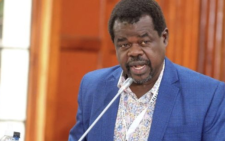

Roba defended the Senate’s proposal, saying the figure was informed by consultations and the financial demands facing county governments.
He cited pending implementation of Salaries and Remuneration Commission advisories and funding requirements for programmes such as County Aggregation and Industrial Parks (CAIPs), Community Health Promoters (CHPs), the Financing Locally-Led Climate Action Programme (FLLoCA), the Food Systems Resilience Project (FSRP), and the National Agricultural Value Chain Development Project (NAVCDP).
“Counties are grappling with mounting pending bills and disrupted service delivery. Our proposal is not arbitrary – it is informed by realities on the ground,” Senator Roba said.
Senator Ledama Olekina said counties were struggling to meet operational costs and constitutional obligations, while Sen. Tabitha Mutinda urged proper funding of devolved functions.
National Assembly cites fiscal pressures
Members of the National Assembly acknowledged the importance of devolution but raised concerns over the country’s fiscal position.
Atandi noted that discussions had previously centred on gradually increasing county allocations to Ksh450 billion, but current economic conditions required caution. Lawmakers pointed to a projected Ksh200 billion revenue shortfall and a national budget estimated at Ksh4.8 trillion, with a deficit of about Ksh1.1 trillion.
“All of us support devolution, but we must make responsible decisions that safeguard the country’s fiscal sustainability,” said Mwengi Mutuse.
National Assembly Health Committee Chair Robert Pukose said counties could also benefit from supplementary funding streams, including allocations under the Primary Healthcare Fund. He called for prudent management of available resources.
Outcome to shape county service delivery
The outcome of the mediation talks will determine the amount of funding available to counties for the 2026/27 financial year. County governments rely on equitable share allocations to fund services in sectors such as health, agriculture, infrastructure, water, and climate resilience.
The committee is expected to continue its deliberations next week before presenting a harmonised version of the Bill for approval by both Houses of Parliament.
Once an agreement is reached, the Division of Revenue Bill will provide the framework for sharing nationally raised revenue between the national and county governments, paving the way for implementation of the new budget cycle.
Author
Latest News

Advertisement
More on Business