Advertisement
COFEK sheds spotlight on Ksh30B Eurobond breach flagged in audit
Monday 04th May, 2026 08:29 AM|

The Consumers Federation of Kenya (COFEK) has brought renewed attention to the use of proceeds from Kenya’s Ksh193.9 billion ($1.5 billion) Eurobond, insisting that questions raised in the Auditor-General’s report still remain unresolved.
Although the findings were tabled in Parliament weeks earlier, COFEK says the scale of the breach and gaps in accountability deserve continued public scrutiny.
Kenya issued the Eurobond at an interest rate of 9.5 per cent, raising about Ksh193.9 billion. The government told investors that the money would be used strictly for external debt restructuring. This included buying back a maturing $900 million Eurobond worth about Ksh116.33 billion and refinancing other external obligations.
These conditions were set out in binding legal documents, including the subscription agreement, offering circular, and deed of covenant. In simple terms, a subscription agreement is a contract between the government and investors that sets strict rules on how borrowed money must be used.
You Might Also Like

It protects lenders by ensuring funds are not diverted to unrelated spending. Any major change in use without approval can amount to a breach of contract.
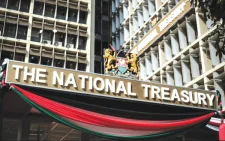
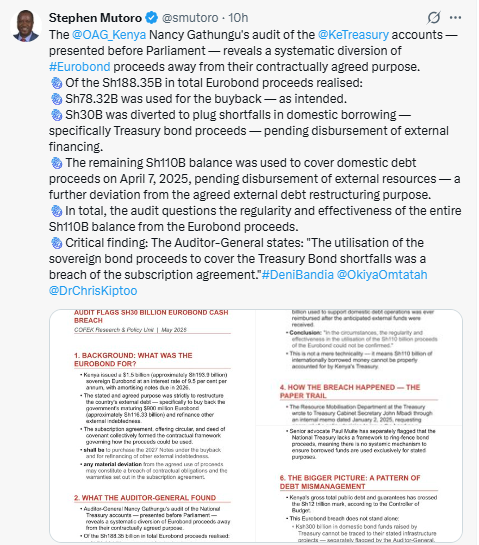
According to Auditor-General Nancy Gathungu’s audit of the National Treasury accounts, the actual use of funds did not fully match those conditions. The government received Ksh188.35 billion in proceeds. Of this, Ksh78.32 billion was used to complete the agreed buyback of the earlier Eurobond. That part followed the stated purpose.
However, the audit found that Ksh30 billion was diverted to cover shortfalls in domestic borrowing. The money was used to plug gaps in Treasury bond proceeds while the government waited for other external financing to arrive. Later, on 7 April 2025, the remaining Ksh110 billion balance was also used to settle domestic debt obligations instead of being strictly applied to external debt restructuring.
Audit flags Ksh110 billion
The Auditor-General raised a clear concern over this approach. She stated that using Eurobond proceeds to cover domestic borrowing needs amounted to a breach of the subscription agreement. She further noted that the Treasury failed to provide sufficient documentation to support full accountability of how the funds were applied.
As a result, she could not confirm whether the Ksh30 billion used for domestic support was ever reimbursed once external funds were received.
Her conclusion was firm: the regularity and effectiveness of the use of the Ksh110 billion balance could not be confirmed.
COFEK says the audit findings point to a deeper governance problem. The organisation has reconstructed a timeline showing how decisions were made inside the Treasury. On January 2, 2025, the Resource Mobilisation Department wrote to Treasury Cabinet Secretary John Mbadi seeking approval to classify the Eurobond as a “national sovereign bond for liability management operation”.
On May 6, 2025, the Director-General of the Public Debt Management Office confirmed in writing that Ksh78.32 billion had been used for the buyback, while Ksh110 billion went to domestic debt support. A few days later, on 15 May 2025, a legal opinion issued to Principal Secretary Chris Kiptoo warned that diverting the funds from their agreed purpose would go against the terms of the bond.
Despite that warning, the diversion proceeded. COFEK argues that this sequence shows clear disregard for both contractual terms and internal legal advice. It adds that the issue is not simply procedural. Kenya continues to pay interest on the full borrowed amount, including funds whose use is now in question.
The federation says the matter remains important because it affects public debt transparency and investor confidence. It has urged Parliament and the public to keep pressure on the National Treasury to fully account for the Ksh110 billion and clarify whether any reimbursement was made.
Author
Kenneth Mwenda
Kenneth Mwenda is a business, sports, and politics digital writer with over seven years of experience in journalism, covering breaking news, feature stories, and in-depth analysis across a range of beats.
For inquiries, he can be reached at [email protected]
View all posts by Kenneth MwendaLatest News


Advertisement
More on Business