Advertisement
CBK says Kenya’s economy stabilising as inflation eases and shilling holds firm
Friday 05th December, 2025 11:20 PM|

Central Bank of Kenya (CBK) says the country’s economy showed signs of stability at the start of December, with inflation easing, the shilling holding steady, and foreign exchange reserves remaining well above the legal threshold.
Headline inflation fell to 4.5 per cent in November, down from 4.6 per cent in October. This drop was driven by lower core inflation, which outweighed rising non-core prices.
“Headline inflation declined to 4.5 per cent in November from 4.6 per cent in October 2025, on account of a lower core inflation which outweighed the increase in non-core inflation,” CBK stated.
Core inflation, which excludes volatile items such as food and energy, decreased to 2.3 per cent from 2.7 per cent in October. This was mainly due to lower prices for processed food items.
You Might Also Like



“Core inflation declined to 2.3 per cent from 2.7 per cent in October mainly due to lower processed food items inflation,” CBK added.
Non-core inflation, which captures items like fresh vegetables, increased to 10.1 per cent from 9.9 per cent, driven by higher prices for selected fresh produce.
Shilling stabilising
The Kenyan shilling remained stable against major international and regional currencies. It traded at 129.41 shillings per US dollar on December 4, compared to 129.86 shillings per US dollar the previous week.
“The Kenya Shilling remained stable against major international and regional currencies during the week ending December 4, 2025,” CBK confirmed.
Foreign exchange reserves continued to provide adequate cover for imports. They stood at 12.03 billion dollars, equivalent to 5.2 months of import cover.
“The foreign exchange reserves remained adequate at USD 12,030 million (5.2 months of import cover) as of December 4,” the CBK said, noting that this meets the statutory requirement of maintaining at least four months of import cover.
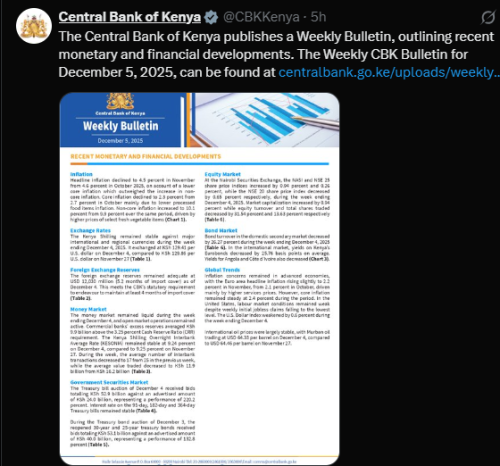
The money market remained liquid, with commercial banks holding excess reserves of 9.9 billion shillings above the required cash reserve ratio. The Kenya Shilling Overnight Interbank Average Rate (KESONIA) remained steady at 9.24 per cent.
Government securities continued to attract strong investor demand. The Treasury bill auction of December 4, 2025, received bids totalling 52.9 billion shillings against an advertised amount of 24 billion.
“The Treasury bill auction of December 4 received bids totalling Ksh52.9 billion against an advertised amount of KSh 24.0 billion,” CBK said. Interest rates on the 91-day, 182-day, and 364-day bills remained stable.
Auctions
Bond auctions also performed well. During the December 3, 2025, auction, the reopened 30-year and 25-year treasury bonds received bids totalling 53.1 billion shillings against an advertised amount of 40 billion.
“The reopened 30-year and 25-year treasury bonds received bids totalling Ksh 53.1 billion against an advertised amount of KSh 40.0 billion,” the CBK confirmed.
At the Nairobi Securities Exchange, the NASI and NSE 25 indices increased by 0.94 per cent and 0.26 per cent, respectively, while the NSE 20 index fell by 0.65 per cent. Market capitalisation rose, even as equity turnover and total shares traded decreased.
Bond turnover in the domestic secondary market fell by 26.27 per cent. Meanwhile, Kenya’s Eurobond yields improved in the international market, falling by an average of 25.76 basis points.
“Bond turnover in the domestic secondary market decreased by 26.27 per cent. Yields on Kenya’s Eurobonds decreased by 25.76 basis points on average,” the CBK said.
Author
Ascah Mwango
View all posts by Ascah MwangoLatest News








Advertisement
More on Business