CBK retains lending rate at 8.75% amid rising inflation pressures
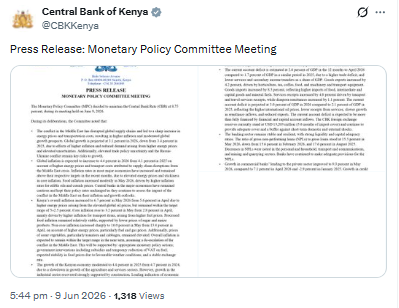
By Kenneth Mwenda, June 9, 2026The Central Bank of Kenya (CBK) has held the Central Bank Rate (CBR) at 8.75 per cent for a second time in a row following its Monetary Policy Committee (MPC) meeting on June 9, 2026, as it seeks to anchor inflation expectations amid rising global and domestic price pressures.
The decision comes at a time when inflation in Kenya is rising again, mainly driven by higher energy costs linked to global oil price increases. Headline inflation rose to 6.7 per cent in May 2026, up from 5.6 per cent in April.
Non-core inflation recorded a sharper jump to 16.0 per cent from 13.4 per cent over the same period, reflecting increases in fuel, gas, and selected food items.
CBK said the decision to hold the rate unchanged was guided by both global risks and domestic price developments.
“The Committee concluded that the current monetary policy stance, with the Central Bank Rate unchanged at 8.75 per cent, remains appropriate to ensure that inflation expectations remain anchored within the target range, and the exchange rate remains stable,” the MPC stated.
Global shocks driving inflation pressure
The MPC noted that the conflict in the Middle East has disrupted global supply chains, pushing up energy prices and transport costs. This has slowed global growth and increased inflation pressures across major economies.
Global growth is projected at 3.1 per cent in 2026, down from 3.4 per cent in 2025, while global inflation is expected to rise to 4.4 per cent from 4.1 per cent.
According to CBK, elevated energy prices and ongoing geopolitical risks, including the Russia-Ukraine conflict, continue to affect global price stability and trade flows.
Central banks in major economies have also maintained cautious monetary policy stances, keeping interest rates steady as they monitor the impact of these shocks.
In Kenya, inflation has remained within the government target range of 5 ± 2.5 per cent, despite recent increases. Core inflation rose to 3.2 per cent in May from 2.8 per cent in April, driven mainly by transport costs linked to fuel prices.
Processed food inflation remained stable, supported by lower sugar and maize prices, but vegetables such as tomatoes and cabbages remained elevated.
CBK expects inflation to remain within the target range in the near term, assuming a stabilisation of global oil prices and supportive domestic conditions, including favourable weather and stable exchange rates.
“The Committee noted that overall inflation is expected to remain within the target range in the near term, assuming a de-escalation of the conflict in the Middle East,” the statement said.
Growth slows as uncertainty rises
Kenya’s economic growth slowed to 4.6 per cent in 2025 from 4.7 per cent in 2024, mainly due to weaker performance in agriculture and services. However, the industrial sector recorded stronger growth supported by construction activity.
CBK projects growth at 4.9 per cent in 2026, down from a previous estimate of 5.3 per cent, citing continued global and domestic uncertainty.
Business confidence surveys show mixed signals. While firms remain optimistic about agriculture, infrastructure spending, and digital growth, concerns remain over high costs of doing business, inflationary pressure, and weak consumer demand.
The banking sector showed signs of recovery in credit uptake. Private sector credit growth increased to 9.3 per cent in May 2026, up from 7.1 per cent in April 2026.
CBK attributed the improvement to lower lending rates and stronger demand in key sectors such as trade, construction, agriculture, and consumer goods.
Average commercial bank lending rates declined to 14.5 per cent in May from 14.7 per cent in April, continuing a downward trend from 17.2 per cent in late 2024.
Non-performing loans (NPLs) also eased to 15.3 per cent from 15.6 per cent in February, reflecting improvements in repayment performance across some sectors, including transport and personal lending.
Banks push for tighter policy ahead of MPC
Ahead of the Monetary Policy Committee meeting, banks had already signalled pressure for tighter monetary policy, citing rising inflation risks and uncertainty in global energy markets.
The Kenya Bankers Association (KBA) argued that inflation expectations were becoming unanchored and called for a policy response to stabilise prices.
“A timely upward adjustment of the Central Bank Rate will effectively anchor inflation expectations and support price stability in the medium term,” the association said in its Research Note No. 3 of 2026.

The lobby group noted that rising fuel costs were feeding into transport, manufacturing, and food prices, increasing the risk of second-round inflation effects. It also pointed to a shift in banking behaviour, with lenders increasingly favouring Treasury bills over private sector lending due to uncertainty in the interest rate environment.
Banks, it said, were becoming more cautious as inflation trends made credit risk harder to price.
External position remains stable but under pressure
Kenya’s external position remains relatively stable, supported by foreign exchange reserves of $13.2 billion, equivalent to 5.6 months of import cover.
However, the current account deficit widened to 2.6 per cent of GDP in the 12 months to April 2026, up from 1.7 per cent in the same period in 2025. This was driven by a higher trade deficit and increased imports of fuel and capital goods.
Goods exports rose by 4.2 per cent, supported by horticulture, tea, coffee, and machinery exports. Imports increased faster at 8.5 per cent, reflecting higher energy and food costs.
Banks and inflation risks shape lending behaviour
Rising inflation and global uncertainty continue to shape how banks and businesses behave in the economy. As inflation increases, lenders face a higher risk of defaults, while borrowers struggle with higher repayment costs.
This has made monetary policy decisions more sensitive. A tighter policy could help anchor inflation but slow credit growth, while a looser policy could support borrowing but risk further price increases.
The Kenya Bankers Association has recently argued that inflation risks require a firmer monetary stance, warning that expectations may become unanchored if price pressures persist.
Banks have also increased their focus on government securities such as Treasury bills, which offer safer returns compared to private sector lending during periods of uncertainty.
CBK said it will continue to monitor global oil prices, inflation trends, and second-round effects on the economy, and remains ready to adjust policy if needed.
“The Committee will meet again in August 2026,” CBK Governor Kamau Thugge said.