CBK releases latest foreign exchange rates showing shilling stability
By Sharon Atieno, June 2, 2026In a statement posted on its official X account on Tuesday, 02 June 2026, the Central Bank of Kenya (CBK) released the daily indicative foreign exchange rates showing the Kenya Shilling maintaining relative stability, though still facing mild pressure against major global currencies.
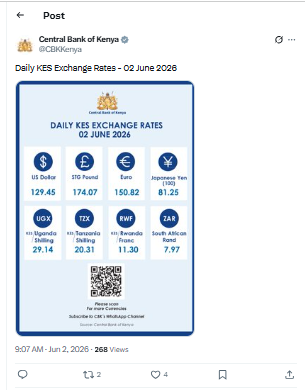
According to the CBK update, the US Dollar traded at Ksh129.45, the British Pound at Ksh174.07, and the Euro at Ksh150.82, reflecting continued demand for hard currencies in the local market.
The Japanese Yen (100 units) was quoted at Ksh81.25, while regional currencies also recorded mixed movements against the shilling.
Regional currencies reflect mixed performance
The Uganda Shilling exchanged at Ksh29.14, the Tanzania Shilling at Ksh20.31, and the Rwanda Franc at Ksh11.30, while the South African Rand stood at Ksh7.97.
CBK noted that the regional currency movements continue to reflect underlying trade patterns, cross-border payments, and seasonal foreign exchange demand pressures.
Market stability under watch
The Central Bank continues to monitor developments in the foreign exchange market, emphasising that the shilling remains broadly stable, supported by monetary policy measures and adequate foreign exchange buffers.

The update comes against the backdrop of recent monetary policy decisions in which the CBK retained the Central Bank Rate (CBR) at 8.75 per cent, a move aimed at anchoring inflation expectations and supporting currency stability.
Inflation and policy outlook
CBK has previously indicated that inflation remains within the target range, supported by easing food prices and stable core inflation, even as global energy prices and geopolitical tensions continue to present risks.
The bank also maintains that Kenya’s foreign exchange reserves remain sufficient to cushion against external shocks, providing stability to the local currency in the short term.
Market participants are expected to closely track CBK’s daily updates as the country navigates a cautiously stable but pressure-sensitive forex environment.