Advertisement
CBK: Kenyan shilling remains stable amid global economic fluctuations
Saturday 13th September, 2025 07:38 AM|

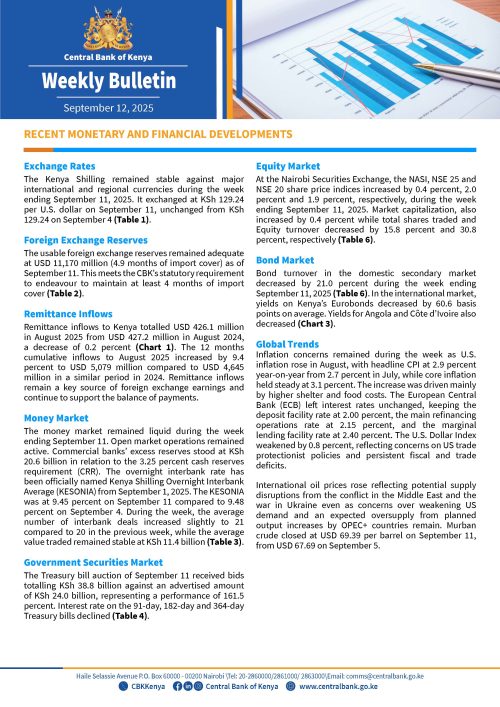
The Central Bank of Kenya (CBK) reported on Friday, September 12, 2025, that the Kenyan shilling remained stable against major international and regional currencies during the week ending September 11, 2025.
According to the CBK Weekly Bulletin, the shilling exchanged at Ksh129.24 per US dollar on September 11, unchanged from Ksh129.24 on September 4, reflecting a steady performance amid global economic fluctuations.
“The Kenya shilling remained stable against major international and regional currencies during the week ending September 11, 2025. It exchanged at Ksh 129.24 per U.S. dollar on September 11, unchanged from Ksh 129.24 on September 4,” read the CBK report.
Foreign reserves and remittances
The CBK noted that foreign exchange reserves continued to cushion the economy.
You Might Also Like



“The usable foreign exchange reserves remained adequate at USD 11,170 million (4.9 months of import cover) as of September 11,” the report stated.
This level exceeds the statutory minimum of 4 months, providing a critical buffer against external shocks.
Remittance inflows also played a supportive role, remaining a key source of foreign exchange earnings. Inflows stood at Ksh55.07 billion in August 2025, a slight dip from Ksh55.21 billion in August 2024. Over the past 12 months, cumulative inflows rose by 9.4 per cent to Ksh 656.41 billion compared to Ksh 600.32 billion in a similar period in 2024, helping to reinforce the balance of payments.
“Remittance inflows to Kenya totalled USD 426.1 million in August 2025, from USD 427.2 million in August 2024, a decrease of 0.2 percent. The 12-month cumulative inflows to August 2025 increased by 9.4 per cent to USD 5,079 million compared to USD 4,645 million in a similar period in 2024. Remittance inflows remain a key source of foreign exchange earnings and
continue to support the balance of payments.”
Money and securities markets
The money market remained liquid during the review week. Commercial banks’ excess reserves were at Ksh 20.6 billion, above the 3.25 per cent cash reserve requirement. The Kenya Shilling Overnight Interbank Average (KESONIA) rate stood at 9.45 per percent on September 11, slightly down from 9.48 per cent the previous week. Interbank activity saw an average of 21 deals daily, with the value traded holding steady at Ksh 11.4 billion.
In the government securities market, strong demand was evident. The Treasury bill auction on September 11 attracted bids totalling Ksh 38.8 billion against an advertised Ksh 24.0 billion, achieving a performance rate of 161.5 percent.
Interest rates on the 91-day, 182-day, and 364-day bills declined. CBK accepted Ksh 28.91 billion, comprising Ksh 15 billion in competitive bids and Ksh 13.87 billion in non-competitive bids.
“The Treasury bill auction of September 11 received bids totalling KSh 38.8 billion against an advertised amount of KSh 24.0 billion, representing a performance of 161.5 percent. Interest rates on the 91-day, 182-day and 364-day Treasury bills declined,” read the report.
Equities, bonds and global trends
At the Nairobi Securities Exchange, the NASI, NSE 25, and NSE 20 share price indices gained 0.4 per percent, 2.0 per percent, and 1.9 per percent respectively. However, equity turnover fell by 30.8 per cent. Bond turnover in the domestic secondary market dropped by 21.0 per cent, while Kenya’s Eurobond yields eased by 60.6 basis points.
Globally, U.S. inflation rose to 2.9 percent in August, driven by shelter and food costs. Oil prices edged up, with Murban crude closing at Ksh 8,968 per barrel, reflecting tensions in the Middle East and the ongoing war in Ukraine.
International oil prices rose, reflecting potential supply disruptions from the conflict in the Middle East and the war in Ukraine, even as concerns over weakening US demand and an expected oversupply from planned output increases by OPEC+ countries remain. Murban Crude closed at USD 69.39 per barrel on September 11, from USD 67.69 on September 5.
Author
Latest News





Advertisement
More on Business