Bankers Association warns PAYE relief for low earners could trigger revenue gap
By Kenneth Mwenda, June 6, 2026The Kenya Bankers Association (KBA) has warned that proposed PAYE relief for low-income earners could create a gap in government revenue, reigniting debate on how Kenya should structure income tax in the Finance Bill 2026.
In a post shared on its official X account on Saturday, June 6, 2026, KBA welcomed Treasury’s proposal to exempt workers earning below Ksh30,000 from tax and to give a 5 per cent relief for those earning up to Ksh50,000.
However, the association cautioned that targeting relief only at lower-income earners may weaken revenue collection and fail to stimulate broader economic activity.
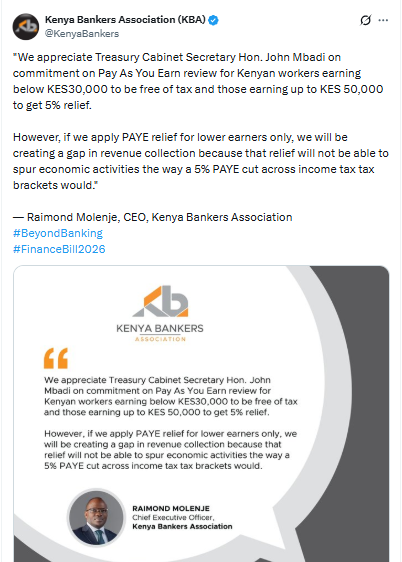
“We appreciate Treasury Cabinet Secretary Hon. John Mbadi on commitment on Pay As You Earn review for Kenyan workers earning below KES30,000 to be free of tax and those earning up to KES 50,000 to get 5% relief,” KBA CEO Raimond Molenje said.
He added:
“However, if we apply PAYE relief for lower earners only, we will be creating a gap in revenue collection because that relief will not be able to spur economic activities the way a 5% PAYE cut across income tax tax brackets would.”
Bankers push for broader PAYE cuts across all brackets
The bankers’ body is advocating for a wider tax cut across all income groups, arguing that a uniform reduction would stimulate consumption, improve liquidity and support economic growth.
KBA has previously proposed a 5 per cent PAYE reduction across all tax bands, saying it could increase disposable income and boost economic activity.
According to the association, every Ksh1 billion released into the economy has a strong multiplier effect on jobs and credit uptake.
Molenje noted that increased disposable income could improve lending activity and support economic expansion.
Stakeholders divided over PAYE structure
The PAYE debate has attracted input from multiple stakeholders, including accountants, legal experts and tax consultants. Most have called for lower PAYE rates and higher personal relief thresholds.
Key proposals include:
- A tax-free threshold of Ksh30,000 monthly income
- Reduced top PAYE rate from 35 per cent to between 28 per cent and 30 per cent
- Increased personal relief from Ksh 2,400 to Ksh3,000
- A five-band progressive PAYE structure
These proposals aim to address rising living costs and shrinking disposable incomes among salaried workers. Here is comparison of PAYE proposals in finance bill 2026:
| Institution | Key Proposal | Main Objective |
|---|---|---|
| Kenya Bankers Association | 5 per cent PAYE cut across all bands | Boost consumption and revenue stability |
| ICPAK | Reduce top rate to 28 per cent and raise relief | Improve fairness in taxation |
| LSK | Tax-free threshold of Ksh30,000 | Ease pressure on low-income earners |
| Treasury proposal | Relief for earnings below Ksh50,000 | Support low-income households |
The National Treasury now faces competing demands. On one side, it must maintain stable revenue collection. On the other, it faces pressure to ease the tax burden on households struggling with high living costs.
PAYE remains one of Kenya’s most reliable revenue sources, contributing hundreds of billions of shillings annually. Any reduction risks widening the fiscal gap unless balanced with alternative revenue measures.
Experts argue that the government must carefully weigh economic stimulation against fiscal stability.
Economic pressure drives calls for PAYE reform
Kenyan households continue to face rising costs of food, transport, rent and healthcare. At the same time, workers are also affected by multiple statutory deductions, including social health contributions, housing levy and NSSF contributions.

This has significantly reduced disposable income for salaried workers. The cumulative effect of increased taxes and statutory deductions has significantly reduced disposable income and purchasing power.
PAYE and wider economic impact
Supporters of PAYE reduction argue that lower taxes could increase consumer spending and strengthen the domestic economy.
They believe higher disposable income could:
- Boost retail activity
- Improve SME cash flow
- Increase bank lending activity
- Support job creation
However, critics warn that targeted relief could reduce revenue without generating enough economic expansion to compensate for the loss.
The PAYE discussion comes amid wider debates on Kenya’s fiscal strategy, including reliance on income tax and VAT versus expanding corporate taxation.
Transparency and tax fairness remain central issues in ongoing policy discussions.
The outcome of the Finance Bill 2026 negotiations will determine whether Kenya moves toward broader tax relief or maintains its current revenue structure.