Advertisement
African nations hike fuel prices amid Middle East oil crisis
Wednesday 01st April, 2026 09:05 PM|

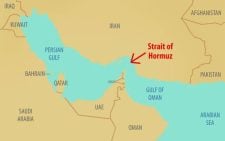
African countries have begun to raise fuel prices as the war in the Middle East drives up global oil costs. The conflict, which started on February 28, 2026 when the US and Israel attacked Iran, forced Tehran to close the Strait of Hormuz. That route carries 20 per cent of the world’s oil.
Brent crude jumped from an average of $69 (Ksh8,970) a barrel in February to $104 (Ksh13,520) a barrel in March. Importers across Africa now face higher costs and longer delivery times.
Eswatini, South Africa, and Namibia
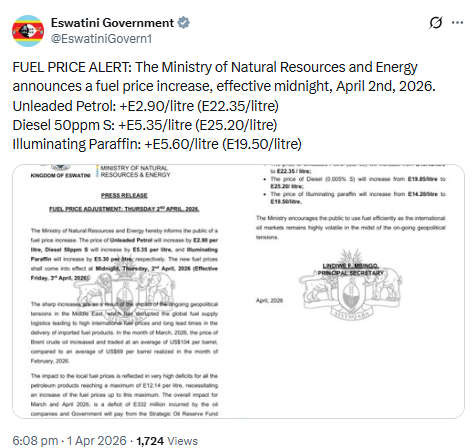
The Kingdom of Eswatini acted first among its neighbours. On April 1, 2026, the Ministry of Natural Resources and Energy issued a press release that spelt out the changes. Unleaded petrol will rise by E2.90 (Ksh22) a litre, diesel 50ppm S by E5.35 (Ksh41) a litre, and illuminating paraffin by E5.30 (Ksh41) a litre.
The new prices take effect at midnight on Thursday April 2. The ministry blamed “ongoing geopolitical tensions in the Middle East” for the disruption to supply chains. It noted that local oil companies ran up a deficit of E332 million (Ksh2.5 billion) in March and April.
You Might Also Like

The government will cover part of that from the Strategic Oil Reserve Fund to limit the pain for consumers. The new pump prices are: unleaded petrol (ULP95) from E19.45 (Ksh149) to E22.35 (Ksh171) a litre; diesel (0.005% S) from E19.85 (Ksh152) to E25.20 (Ksh193) a litre; and illuminating paraffin from E14.20 (Ksh109) to E19.50 (Ksh149) a litre.
Principal Secretary Lindiwe F. Mbing o signed the statement and urged the public to use fuel more efficiently while markets stay volatile.
South Africa also raised prices but moved to soften the blow. On April 1, 2026, petrol increased by R3.06 (Ksh23) a litre and diesel by between R7.37 (Ksh56) and R7.51 (Ksh57) a litre. Without government action, the rises would have been far steeper.
Finance Minister Enoch Godongwana announced a one-month cut in the general fuel levy of R3 (Ksh23) a litre. The move costs the state about 6 billion rand (Ksh46 billion) in lost revenue, which ministers say they will recover elsewhere. Godongwana told reporters the government will watch the Middle East and may extend relief into May and June if the fighting continues.
Namibia took stronger steps. Energy Minister Modestus Amutse said on March 27, that the country will slash fuel levies by 50 per cent for three months until the end of June. The Road User Levy and Fuel Levy each drop from N$0.63 (Ksh4.80) to N$0.315 (Ksh2.40) a litre.
Pump prices still rise – petrol by N$2.50 (Ksh19) a litre and diesel by N$4 (Ksh30) a litre – but the National Energy Fund covers the shortfall.
Kenya, Egypt, and Zimbabwe
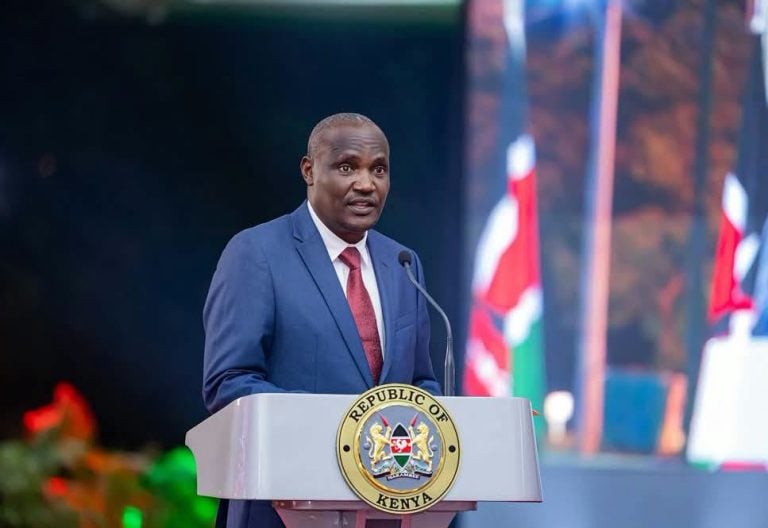
Kenya has held prices steady for now. The Energy and Petroleum Regulatory Authority left April pump prices unchanged thanks to government-to-government deals with Gulf suppliers.
About 20 per cent of stations reported low stocks because of panic buying, but Energy Cabinet Secretary Opiyo Wandayi dismissed any real shortage. On March 25, he warned oil companies:
“We note with grave concern reports of product hoarding and speculative withholding of stocks by some oil marketing companies,” Wandayi said.

He reminded firms that they must sell at EPRA prices or face sanctions. Wandayi added:
“There’s no shortage of fuel in the country. Our systems, from importation through storage and pipeline distribution to the retail network, are functioning as required,” Wandayi added.
Egypt chose direct price rises and cuts in use. The government lifted petrol prices and public transport fares. Shops and restaurants must close by 21:00, street lights dim, and non-essential staff work from home one day a week. Officials slowed energy-intensive projects and trimmed government vehicle fuel allowances by a third.
Zimbabwe mixed higher ethanol with tax relief. It lifted the ethanol blend in petrol from 5 per cent to 20 per cent and scrapped some import taxes. Pump prices had already climbed 40 per cent in less than a month.
Ethiopia, Nigeria, Ghana, and Algeria
Ethiopia focused on saving fuel. State firms ordered remote working, pooled transport and cut executive fuel allowances. Petrol stations now serve public transport first, and authorities suspended supplies in parts of Tigray.
Nigeria, Africa’s top oil producer, still saw pump prices climb. The Dangote refinery receives extra crude, but the Association of Nigerian Petroleum Refinery Marketers called for a temporary subsidy to protect consumers.
Ghana stays calmer than most. Russian shipments help meet demand, and a tanker from Vysotsk is due at Tema on April 6.
Algeria, by contrast, gains. European buyers and even Vietnam now seek extra LNG and fuel from its large reserves.
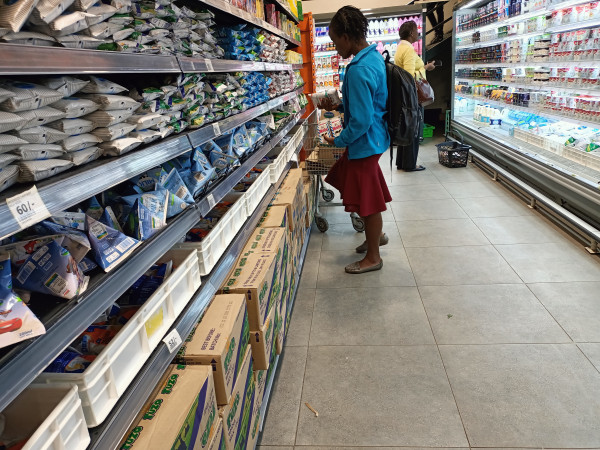
Across the continent governments balance two pressures. They must pass on higher import costs or risk empty fuel tanks. At the same time they try to shield citizens from inflation that hits food transport and industry hardest.
Some raise prices outright, like Eswatini and Egypt. Others cut taxes or levies, like South Africa and Namibia. A few ration or blend, like Ethiopia and Zimbabwe. Kenya relies on advance deals and strict rules against hoarding.
The war shows no quick end. Oil markets remain jumpy, and shipping routes stay longer. African finance ministers will keep watching Brent crude and the Strait of Hormuz. For drivers filling up this week, the message is clear: fuel costs more because distant fighting has reached their pumps.
Author
Kenneth Mwenda
Kenneth Mwenda is a business, sports, and politics digital writer with over seven years of experience in journalism, covering breaking news, feature stories, and in-depth analysis across a range of beats.
For inquiries, he can be reached at [email protected]
View all posts by Kenneth MwendaLatest News



Advertisement
More on Business