Advertisement
AFA warns exporters on immature avocado handling
Saturday 28th March, 2026 10:00 AM|

The Agriculture and Food Authority (AFA) has warned avocado exporters and processors that handling immature fruit will lead to the immediate revocation of packhouse registration and export licenses.
The directive coincides with the opening of the 2025/2026 avocado export season for sea shipments, as Kenya prepares to tap into the Chinese market under a new zero-tariff agreement.
In a notice dated March 25, 2026, AFA Acting Director General Calistus Kundu stated that harvesting of avocados for export by sea will start on April 2.
Packhouse inspections for fresh produce will begin on April 7, with exporters required to apply for inspection at least three days before shipment.
You Might Also Like


“It has been noted that some exporters and processors are harvesting immature avocados. The Authority shall be conducting pack-house and avocado oil processing facility surveillance,” read the AFA X post in part.
“Any processor/exporter found processing/packing immature avocado shall have their packhouse registration and export license revoked.”
Exporters must also submit a list of registered Horticultural Produce Marketing Agents (HPMA) or suppliers by March 30. Harvesting for oil processing, which requires higher maturity indices, will commence on April 30.
Compliance and quality control
The decision follows a field survey conducted from March 1 to 6, 2026, which initially found insufficient mature fruit, delaying the season’s opening.
Recent improvements in fruit maturity have allowed harvesting to begin, but AFA stressed strict adherence to quality standards. “It has been noted that some exporters and processors are harvesting immature avocado,” the notice stated.
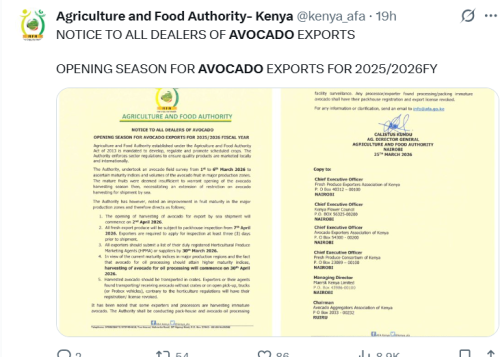
All harvested avocados must be transported in crates. Exporters or agents using open pick-up trucks, Probex vehicles, or other non-compliant transport risk losing their registration or license.
The measures aim to protect Kenya’s reputation in international markets, particularly for varieties like Hass, where buyers demand consistent quality. Immature fruits risk damaging trade relationships and affecting farmer incomes.
Opportunities in the Chinese market
The warning comes shortly after Kenya and China marked a trade milestone. On March 23, 2026, Deputy President Kithure Kindiki and Chinese Vice President Han Zheng flagged off the first consignment of Kenyan exports under a zero-tariff arrangement.
From May 1, 2026, 98.2 percent of Kenyan exports to China, including avocados, avocado oil, coffee, and hides, will enter duty-free, giving access to over 1.4 billion consumers.
Investments, Trade and Industry Cabinet Secretary Lee Kinyanjui called the policy “a game changer,” noting that zero duty on avocados will boost exports, encourage value addition, create jobs, and narrow the trade deficit.
Author
Latest News








Advertisement
More on Business