Advertisement
Boston welcomes Kipchoge
Friday 14th April, 2023 07:00 AM|
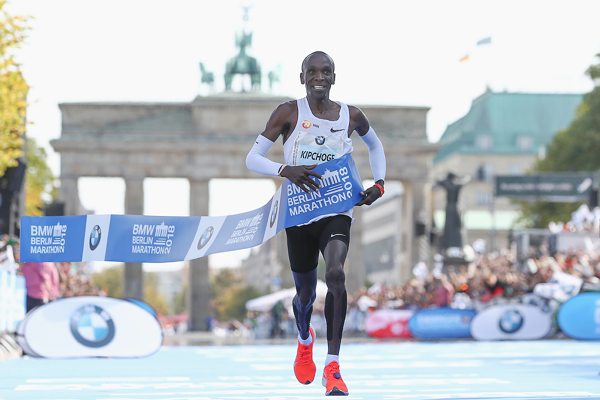
Since its inaugural edition in 1897, the Boston Marathon has seen almost everything. It has seen Nor’Easters and scorching temperatures. Women have gone from being attacked for daring to run the race to celebrated for creating some of its most iconic moments. The finish line on Boylston Street has been the site of glory, farce, and tragedy. But through its first 126 editions, the world’s oldest annual marathon is still missing one thing. None of those races have featured the great Eliud Kipchoge (pictured).
In the year 2023, people like to debate and argue about almost everything. You can debate whether Boston is the world’s most iconic marathon. But in the year 2023, there is zero debate about the world’s most iconic marathoner. It’s Kipchoge, the 38-year-old Kenyan whose calm demeanor and habit for dispensing aphorisms often invoke religious comparisons (“ascetic monk” and “Zen master” are two popular descriptors).
Kipchoge has accomplished more than anyone thought possible in the marathon since his debut in 2013. Back then, anyone who claimed the unofficial title of World’s Greatest Marathoner never held it for long. Geoffrey Mutai earned it by winning Boston and New York in 2011, then Berlin in 2012 and New York in 2013. But that was it — Mutai would run just three more marathons in his career, never finishing higher than 5th, and retire at 34.
Wilson Kipsang, Mutai’s successor as World #1, had an even briefer reign at the top. Kipsang earned the belt by winning Berlin in 2013, followed by London and New York in 2014. Then it was Kipchoge’s turn. After wins in Rotterdam and Chicago in 2014, Kipchoge seized the crown by beating Kipsang in London in 2015.
Recent history said that by 2017, someone new would show up to usurp Kipchoge, just as he had usurped Kipsang. But Kipchoge just kept winning. Seven straight victories. Eight. Nine. After more than seven years unbeaten, Kipchoge finally lost a marathon in London in 2020 — and promptly responded by ripping off four more victories, including an Olympic title in 2021 and a world record in 2022.
Kipchoge’s résumé towers over his peers. He owns two world records and two Olympic titles. Since the establishment of the World Marathon Majors in 2006, Kipchoge has 12 WMM victories (10 on the regular circuit plus two Olympics). No other man has even half that — Kipsang, who banned four years for whereabouts failures and tampering in 2020, is the next closest at five (Mary Keitany has the most women’s wins, with seven). But Kipchoge has never tested himself on Boston’s unique course.
His career will not feel 100% complete until he does.
Fortunately, we don’t have to wait long. Early on the morning of April 17, Kipchoge will board a bus bound for the start line in Hopkinton. He will be dropped off at the Hopkinton Town Common on Main Street, where he and the other 63 athletes in the men’s professional division will spend their final hours before the race.
And then, at 9:37 a.m., the starting gun will fire and Kipchoge will run the Boston Marathon for the very first time.
If you are anywhere near the marathon course on Monday, you owe it to yourself to take a few minutes out of your day to catch a glimpse of Kipchoge in person. What Babe Ruth, Tom Brady, Michael Jordan, and Wayne Gretzky were to their sports, Kipchoge is to the marathon. He has not raced in the United States for nine years, and may only race here once more (he’s expected to run the New York City Marathon in November). Kipchoge’s marathons are masterpieces, and while he has shown no signs of slowing down — he broke the world record in his most recent marathon — we are far closer to the end of Kipchoge’s career than the beginning. Who knows how many more opportunities there will be to see him at the peak of his powers?
Apologies if this is veering into hagiography. But the opportunity to see Kipchoge tackle the Newton Hills, run through Kenmore Square, and make the famous right turn onto Hereford and left turn onto Boylston is profoundly cool. Finally, we will get an answer to one of the sport’s great hypotheticals: How will the master of the flat, rabbitted marathon fare in a race that is neither of those things? If Eliud Kipchoge in the Boston Marathon does not excite you as a running fan, there is nothing in this sport that will.
A marathon is different when Eliud Kipchoge is in the field. Early in the 2016 Olympic marathon in Rio, Kipchoge sped up approaching a drinks station to get a clear line to his bottle. Just as the rest of the contenders prepared to answer his move, Kipchoge turned around.
“Don’t worry,” he told them, “I’m not going yet.”
Kipchoge slowed back down, and so did the rest of the field. Kipchoge waited until 20 miles to make his move, ripping off a 4:41 mile followed by a 4:35. He won the race by 70 seconds.
“When Kipchoge speaks, you listen,” says veteran US marathoner Jared Ward. “And when he moves, you react. I think a lot of us run the race like that with him, whether or not it’s totally intentional. He just has the respect of everybody in the field.”
Ward finished 6th in that 2016 Olympic marathon, and by 2019 had established himself as a world-class marathoner with top-10 finishes in New York and Boston. The night before that year’s New York City Marathon, Ward was enjoying a pre-race meal with his wife, Erica, and some of the other elite athletes. Ward was in the middle of a dinner of chicken and roasted red potatoes when he noticed someone walk into the room that caused him to drop his fork — potato and all. Erica quickly asked what had happened. “That’s Eliud Kipchoge,” he told her.
“I’d been in the sport for a while and I felt like I had moved past the phase of being starstruck,” Ward said. “But even three years after racing Kipchoge in the Olympics, he walks into the room and I still drop my fork.”
Kipchoge’s unprecedented marathon success has earned him an uncommon level of respect in the marathon. Top marathoners only race a couple of times a year, which means they’re not always intimately familiar with their competitors; after outdueling him to win the Boston Marathon in 2017, Geoffrey Kirui didn’t know Galen Rupp‘s name despite Rupp having earned Olympic bronze eight months earlier. Everyone on the elite start line on Monday will know exactly who Kipchoge is.
Claudio Berardelli, coach of Benson Kipruto and Evans Chebet, the last two Boston Marathon champions, says Kipchoge’s presence in the race “changes everything.”
“Everybody knows, including Benson and Evans, that if Eliud in shape, he is the man to beat,” Berardelli said. “Of course, with all the respect for the rest of the athletes.”
Author
Story Agencies
View all posts by Story AgenciesLatest News


Advertisement
More on Sports