AIU suspends Kenya’s Hillary Kipchirchir for doping
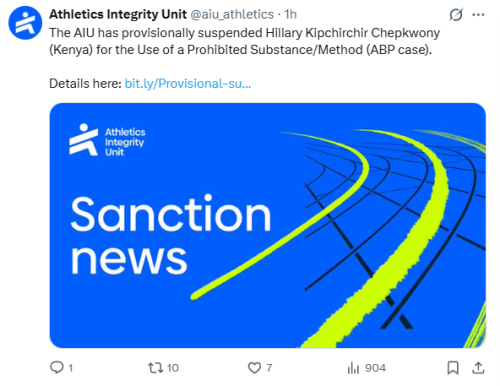
By Joel Masibo, December 9, 2025The Athletics Integrity Unit (AIU) has provisionally suspended Hillary Kipchirchir Chepkwony (Kenya) for the use of a Prohibited Substance/Method (ABP case).
The 26-year-old marathon runner’s provisional suspension was announced by the AIU on Tuesday, December 9, 2025, as the doping watchdog continues to keep an eye on Kenyan athletes in the wake of increasing sanctions over failure to comply with anti-doping regulations.
AIU cracks whip
”The AIU has provisionally suspended Hillary Kipchirchir Chepkwony (Kenya) for the Use of a Prohibited Substance/Method (ABP case),” AIU said via X.
Meanwhile, ahead of the new year 2026, the World Anti-Doping Agency (WADA) produces a list of substances and methods that are banned in sport. The particular prohibited list is a mandatory International Standard under the World Anti-Doping Code and is updated every year following an extensive consultation process.
According to AIU, the 2026 Prohibited List comes into effect on January 1 2026. The List outlines the substances and methods that are prohibited:
At all times (both in- and out-of-competition), or only in-competition, or inn particular sports.
What is on the List?
The substances and methods prohibited at all times include (but are not limited to): Hormones and anabolic agents (e.g. testosterone, growth hormone, EPO), beta-2 agonists, diuretics and masking agents, and prohibited methods such as blood manipulation, chemical or physical tampering, and gene or cell doping.
Those prohibited only in-competition include (but are not limited to): Stimulants, narcotics, cannabinoids, and glucocorticoids.
Meanwhile, Kipchirchir’s provisional suspension comes days after the Anti-Doping Agency of Kenya (ADAK) had enlightened local athletes on the steps taken during the anti-doping test procedure.
The agency has highlighted the step-by-step process involved in urine sample collection for doping control. The procedure, which adheres to international standards set by the World Anti-Doping Agency (WADA), ensures fairness, accuracy, and transparency during athlete testing.
Urine testing plays a crucial role in detecting prohibited substances that may enhance performance unnaturally.