World Radio Day 2026: Kenya launches its first digital sound broadcasting trial
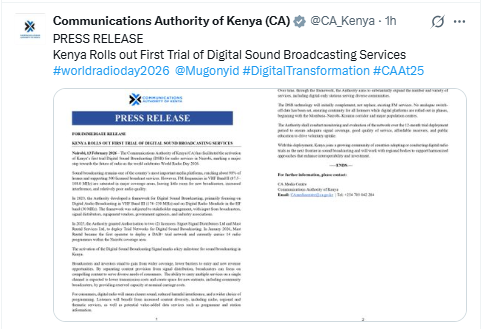
By Kepher Otieno, February 13, 2026Kenya tunes into the future this World Radio Day 2026 as the Communications Authority of Kenya (CA) launches the nation’s first Digital Sound Broadcasting (DSB) trial in Nairobi, ushering in a new era for radio listeners across the country.
Radio remains one of Kenya’s most pervasive and trusted media platforms, reaching approximately 98 per cent of households and supporting more than 300 licensed broadcast services.
Yet, the continued expansion of FM broadcasting faces structural constraints. The VHF Band II spectrum (87.5–108.0 MHz) is saturated in major urban centres, limiting opportunities for new entrants, increasing signal interference, and constraining improvements in audio quality.
“The move toward digital transmission reflects a strategic response to these pressures, positioning Kenya to modernise its broadcasting infrastructure while safeguarding universal access, the statement released on Friday, February 13, 2026, read in part.
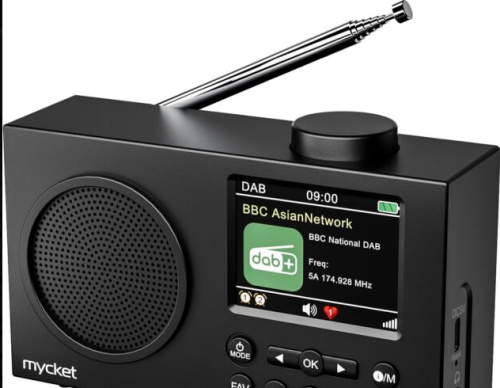
In 2023, the CA established a regulatory framework for Digital Sound Broadcasting, focusing on Digital Audio Broadcasting (DAB+) in VHF Band III (174–230 MHz) and Digital Radio Mondiale (DRM) in the HF band (30 MHz).
The framework followed extensive stakeholder consultations involving broadcasters, signal distributors, equipment vendors, government agencies, and industry associations.
Moreover, in 2025, the authority authorised two licensees, Signet Signal Distributors Ltd and Mast Rental Services Ltd, to deploy trial DSB networks. In January 2026, Mast Rental Services became the first operator to roll out a DAB+ trial network, currently transmitting 14 radio programmes within the Nairobi coverage area.
“The activation of the DSB signal marks Kenya’s first operational step into digital terrestrial radio broadcasting. The transition to digital radio is expected to reshape the broadcasting value chain,” the authority stated.
Boosting contents
In separating content provision from signal distribution, the framework enables broadcasters to focus on programming while licensed network operators manage transmission infrastructure.
Digital multiplexing technology allows multiple radio services to be carried on a single frequency block, reducing transmission costs and freeing up capacity.
The model is projected to lower entry barriers for new broadcasters, including community and niche stations, through reserved capacity at nominal carriage fees.
For investors, the shift opens potential new revenue streams linked to expanded service offerings and value-added data capabilities.
On the other hand, for listeners, Digital Sound Broadcasting promises clearer audio, reduced interference, and expanded programme choice.
“The platform will enable greater content diversity, including thematic, regional, and digital-only stations serving specific communities,” CA said.
In addition, digital radio platforms support enhanced features such as on-screen programme information and station data services, further enriching the listener experience.
Importantly, DSB will initially complement, not replace, existing FM services, which are facing stiff competition from podcasts. No analogue switch-off date has been announced, ensuring continuity of access as digital roll-out proceeds in phases.
The initial deployment will prioritise the Mombasa–Nairobi–Kisumu corridor and other major population centres.
The Authority will conduct a 12-month monitoring and evaluation period to assess signal coverage, service quality, receiver affordability, and public awareness levels to encourage voluntary uptake.