Willis Otieno: Why are Kenyans paying twice for houses built with their own money?
By Sharon Atieno, June 3, 2026Constitutional lawyer and governance commentator Willis Otieno has raised fresh concerns over Kenya’s Affordable Housing Programme, questioning whether salaried Kenyans are unfairly carrying a double financial burden through the Housing Levy framework.
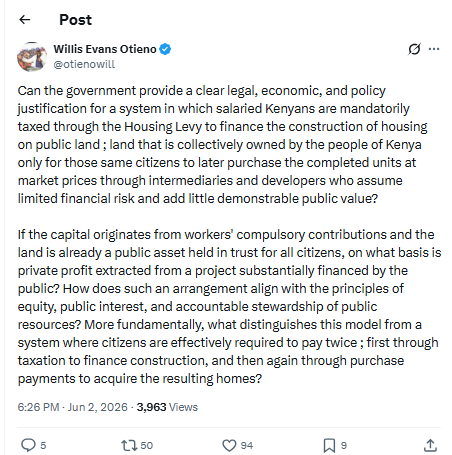
Speaking in a statement shared on his X account on Tuesday, June 02,2026, Otieno questioned the legal and policy basis of a system where workers contribute mandatory deductions toward housing construction, only to later purchase the same houses through market-based arrangements.
“The government must provide a clear legal, economic and policy justification for a system where salaried Kenyans are mandatorily taxed through the Housing Levy to finance construction on public land, and then later purchase those houses,” Otieno argued.
Questions over public financing model
Otieno further questioned the role of private developers and intermediaries within a programme largely financed through workers’ contributions and public land.
According to him, if the capital for construction originates from compulsory deductions and the land belongs collectively to Kenyans, questions arise on how private profit is generated within such an arrangement.
“If the capital originates from workers’ compulsory contributions and the land is already a public asset held in trust for citizens, on what basis is private profit extracted from a project substantially financed by the public?” he posed.
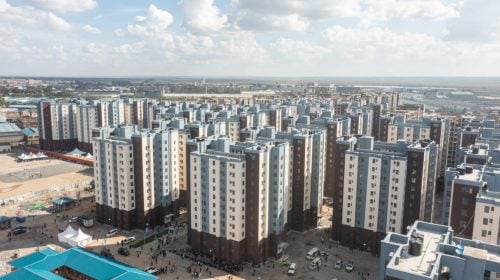
He further questioned whether the current framework aligns with principles of equity, accountability and public interest.
More fundamentally, he argued that many Kenyans may increasingly ask whether the arrangement effectively requires citizens to pay twice first through mandatory contributions and later through purchase payments.
Ruto defends housing levy programme
Otieno’s concerns come months after President William Ruto defended the Housing Levy programme amid growing public scrutiny over accountability and use of collected funds.
Speaking in January 2026, Ruto dismissed criticism surrounding the programme and insisted the deductions were already supporting development and job creation.
“I want to tell contributors that every cent they have contributed to the housing fund must be put to good use,” Ruto said.
The government raised Ksh73 billion under the housing levy during the 2024/2025 financial year, up from Ksh54 billion collected in the previous fiscal year.
The Affordable Housing Programme, introduced through the Finance Act 2023, continues to attract both support and criticism as debates over affordability, transparency and management of public resources persist.