Willis Otieno condemns ethnic politics, calls for national unity
By Faith Lagat, August 23, 2025Political commentator and constitutional lawyer Willis Evans Otieno has launched a sharp critique against leaders exploiting ethnic divisions for personal gain.
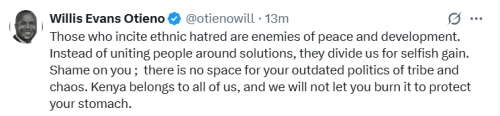
In a fiery post on X dated August 23, 2025, he denounced tribal-based politics as a threat to the nation’s peace and development.
“Those who incite ethnic hatred are enemies of peace and development. Instead of uniting people around solutions, they divide us for selfish gain.
“Shame on you; there is no space for your outdated politics of tribe and chaos. Kenya belongs to all of us, and we will not let you burn it to protect your stomach,” Otieno wrote.
His statement comes amid rising political tensions ahead of the 2027 general elections, highlighting growing frustration with ethnicity-driven campaigns.
Otieno’s remarks directly challenged National Assembly Speaker Moses Wetang’ula, who earlier this month urged the Luhya community to rally behind President William Ruto’s re-election bid to secure a Luhya successor. Critics argue that such appeals perpetuate divisive politics. Otieno dismissed these strategies as empty and counterproductive, urging leaders to prioritise ideology over ethnic considerations.
“Without ethnicity, they are empty. No ideology, no policy, no plan. It’s time to rise above tribe and unite in pain, in purpose, and in power,” he posted on August 3, 2025.
His critique extends to other senior officials, including Interior Cabinet Secretary Kipchumba Murkomen, whom he accused of downplaying police brutality during recent protests. The comments underscore a growing public demand for accountable governance amid economic inequality and social unrest.
Northern frontier
At the Homa Bay conference, themed “For the People, For Prosperity: Devolution as a Catalyst for Equity, Inclusion and Social Justice”, Otieno shifted focus to Kenya’s Northern Frontier counties.
Despite over a decade of devolved funding, the region continues to face deficits in basic services.
“For 12 years of devolution, billions have flowed to the Northern Frontier counties, yet the people still drink dirty water, study under trees, and die of hunger. Don’t blame Nairobi, and don’t blame history; blame your own leaders. They turned devolution into personal bank accounts, building mansions in Nairobi while their people walk barefoot in the dust,” he said.
Citing Transparency International’s 2024 Corruption Perceptions Index, where Kenya scored 32 out of 100, Otieno argued that institutional frameworks alone cannot deliver justice. “Devolution has shown that development can be more responsive, that citizens can have a stronger voice, and that local leadership matters profoundly. But it has also shown that institutions alone cannot deliver justice—only the consistent practice of accountable leadership can,” he added.
Otieno’s statements resonate with reform-minded citizens, emphasising transparency, accountability, and unity over tribal loyalties. As Kenya approaches a critical election cycle, the question remains whether leaders will heed his call or persist with divisive politics that undermine national cohesion.