Why internet companies face tougher rules under latest govt proposal
By Aloys Michael, May 4, 2026Internet providers may soon be forced to raise their game as regulators push for stricter installation rules.
The Communications Authority of Kenya (CAK) has opened the door for public input on new guidelines designed to clean up messy infrastructure, boost safety standards, and make internet services more reliable nationwide.
In a statement on Monday, May 4, 2026, the regulator said the proposed standards are intended to streamline how providers deploy connectivity outside homes and offices, where poor installations have led to slow speeds, frequent outages, and unsafe wiring.
The move follows growing public complaints about poorly installed fibre and internet cables left hanging on poles, walls, and along streets.
“Your internet experience doesn’t start at your phone; it begins with the cables right outside your home or office,” the authority wrote on X.
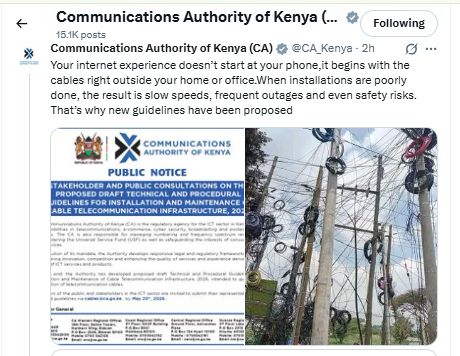
“When installations are poorly done, the result is slow speeds, frequent outages and even safety risks. That’s why new guidelines have been proposed.”
Members of the public have been urged to read the consultation paper and submit their views before May 20, 2026.
The proposal introduces consistent nationwide guidelines governing the design, installation, labelling, sharing, maintenance, and protection of fibre optic and other telecommunications cables.
The regulator says the measures are intended to guarantee safe, dependable, and high-quality deployment of telecom infrastructure, while also advancing standardised technical practices and environmental responsibility.
Improving infrastructure?
In addition, the framework promotes infrastructure sharing and open access, enhances the safeguarding of critical telecom systems, and enforces strict adherence to building, environmental, and safety regulations.
A key focus of the proposal is to phase out overhead wiring and poorly executed cable trenching, practices that have become widespread in many residential areas and commercial hubs.

The authority proposes that all contractors must be licensed and that designs receive prior approval before route identification and submission, which must occur within 30 days after completion.
The plan requires urban trenching to reach a minimum depth of 600 millimetres, with maintenance holes placed every 150 to 200 metres and clearly marked with operator information.
It also mandates that ducts provide extra capacity for future expansion, while fibre deployment should be coordinated with road, rail, and power infrastructure projects to minimise repeated excavation.
Additionally, stricter regulations are outlined for aerial fibre installed on poles, including adherence to safety clearance standards developed in consultation with the Energy and Petroleum Regulatory Authority (EPRA) and electricity providers.
Meanwhile, all new developments, including affordable housing, will need to incorporate broadband ducts and internal conduits from the entry point to individual units, in line with the upcoming Building Code 2025.
If approved, these regulations are set to come into force on July 1, 2026, after being published in the Kenya Gazette.