Weatherman explains malaria outbreak risk with Nandi as the hotspot
By Aloys Michael, May 2, 2026Kenya Meteorological Department (Kenya Met) has warned that rising temperatures are increasing the risk of a malaria outbreak in several counties, with Nandi emerging as a key hotspot.
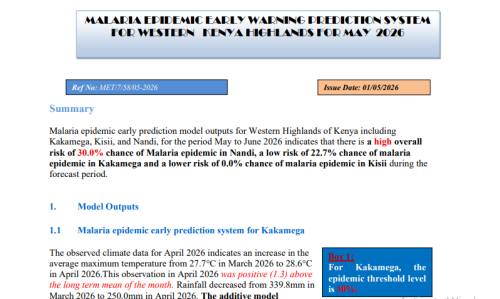
According to Kenya Met‘s bulletin released on Saturday, May 2, 2026, Nandi County has emerged as the hotspot after temperatures rose 1.7°C above the long-term average, pushing the epidemic risk to 30 per cent, above the 20 per cent threshold and signalling a shift in traditionally low-risk highland zones.
“There is a high risk of malaria outbreak in Nandi, noting that warming conditions are now a key driver of transmission, unlike in Kisii, where cooler temperatures kept risk at 0 per cent despite earlier heavy rainfall,” the agency said.
“Hence, there is a high risk of malaria outbreak in the months of May and June 2026,” the bulletin states, warning that warming conditions are creating a favourable environment for disease transmission.
The findings point to a broader change in Kenya’s highland, many of which have historically experienced low malaria transmission due to cooler temperatures. Health experts say that even small temperature increases can accelerate mosquito breeding cycles and allow the parasites they carry to develop faster.
The Nandi alert stands in sharp contrast to Kisii County, where the risk of a malaria outbreak is projected at zero per cent, despite heavy rainfall earlier in the season. The difference, the report notes, lies in temperature trends.
Kakamega County, also part of the western highlands, recorded a 22.7 per cent risk, below the epidemic threshold but still elevated.

The bulletin is based on a malaria early warning system developed jointly by the Meteorological Department, the Kenya Medical Research Institute (KEMRI) and the Ministry of Health (MOH). The system combines climate observations and predictive modelling to flag potential outbreaks weeks in advance.
Officials say the data indicate a critical shift: temperature, rather than rainfall alone, is becoming the key driver of malaria risk in the region.
The report cautions that the projections are subject to change and should not be used as the sole basis for public health decisions.
However, it urges continuous monitoring and early intervention, especially in high-risk counties like Nandi.