Advertisement
Wamuchomba exposes loophole in tea market amid quality scrutiny
Tuesday 25th November, 2025 02:56 PM|
Githunguri Member of Parliament (MP) Gathoni Wamuchomba has raised fresh alarm over a major loophole she says is crippling Kenya’s tea sector and demotivating farmers who have long depended on the crop for their livelihood.
Her remarks come at a time when Kenya’s tea industry is facing renewed scrutiny following reports of declining quality, poor bonuses, and growing frustration among smallholder farmers.
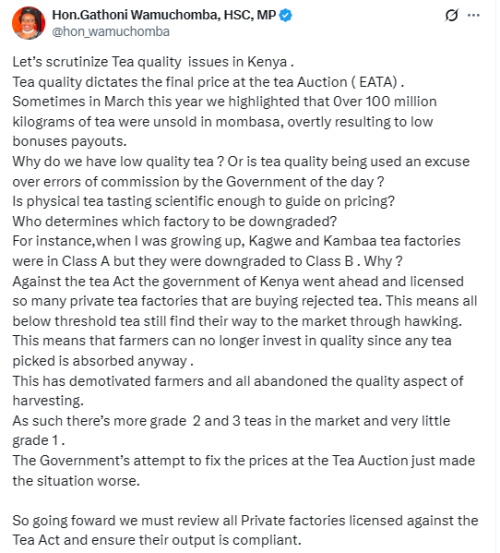
Speaking through an X post posted on Tuesday, November 25, 2025, Wamuchomba accused the government of undermining the Tea Act by licensing numerous private factories that, she said, are buying rejected tea from farmers and middlemen.
Watch: Wamuchomba accuses state of fueling tea crisis through illegal licensing
You Might Also Like



“Against the Tea Act, the government of Kenya went ahead and licensed so many private tea factories that are buying rejected tea. This means all below threshold tea still finds its way to the market through hawking,” the statement reads
Wamuchomba explained that this loophole has removed farmers’ incentive to focus on proper plucking and processing methods, since low-grade tea still gets absorbed into the market without consequence.
“Farmers can no longer invest in quality since any tea picked is absorbed anyway; this has demotivated farmers, and all have abandoned the quality aspect of harvesting,” she stated.

She went on to state that the tea sector recorded worrying statistics recently. In March, farmers were stunned when more than 100 million kilograms of tea went unsold at the Mombasa Tea Auction, a development that led to reduced bonus payouts and financial strain across tea-growing counties.
Referring to the incident, she said, “Sometime in March this year, we highlighted that over 100 million kilograms of tea were unsold in Mombasa, resulting in low bonus payouts,” she stated.
Wamuchomba questioned whether the current quality crisis is genuine or simply being used to conceal failures within government and industry management.
“Why do we have low-quality tea? Or is tea quality being used as an excuse for errors of commission by the government of the day?” she stated, also casting doubt on long-standing grading practices, posing the question. “Is physical tea tasting scientific enough to guide pricing?” she asked
She further wondered why once reputable factories were downgraded from Class A to Class B. “When I was growing up, Kagwe and Kambaa tea factories were in Class A, but they were downgraded to Class B. Why?” she asked.
According to Wamuchomba, the consequences of allowing substandard tea into the market are already visible. She said the country now has more grade 2 and 3 teas in the market.
“This has demotivated farmers, and all abandoned the quality aspect of harvesting. As such, there’s more grade 2 and 3 teas in the market and very little grade 1,” She stated, adding that the government’s attempt to fix prices at the auction made the situation worse.
“The Government’s attempt to fix the prices at the Tea Auction just made the situation worse,” the statement reads
Looking ahead, Wamuchomba called for a strict review of all privately licensed factories and urged the sector to adapt to changing global demands.
“So, going forward, we must review all Private factories licensed under the Tea Act and ensure their output is compliant. We must also understand the changing market dimensions and acknowledge that tea buyers are now keen on Traceability rather than bulk buying, hence the need to invest heavily in Value addition. Unfortunately, our taxation regime is repulsive to tea packers, and this only messes the situation further,” she wrote
Tea quality
The Tea Board of Kenya and the East African Tea Trade Association (EATTA) had earlier called on farmers to tighten quality standards to help lift tea prices at the Mombasa auction. Speaking during a tea quality evaluation in Mombasa, Tea Board CEO Willy Mutai said farmers have made progress but must address remaining challenges that still affect the final product.
“Farmers have really pushed up the quality. We are, however, still urging them to tighten the gaps,” he said, noting that factories also play a key role in ensuring well-processed tea reaches the market.
EATTA’s managing director, George Omuga, emphasised that the Mombasa auction handles tea from 10 African countries, making quality a critical factor in staying competitive. He said tasting showed that the quality of raw materials from the farm has a direct influence on the cup quality and other tea parameters.
Officials urged both farmers and factories to boost their quality efforts to secure better prices.
Author
Latest News








Advertisement
More on News