Advertisement
US Senate calls for independent probe into Tanzania election violence
Tuesday 25th November, 2025 07:15 PM|

The United States Senate Foreign Relations Committee has called for an immediate and independent investigation into the violence that followed Tanzania’s October 29 presidential election.
The demand comes amid reports of mass killings, cover-ups, and human rights violations by Tanzanian security forces.
The call followed a detailed investigation by CNN, led by Kenyan journalist Larry Madowo, which documented deadly crackdowns on protesters. The report included satellite imagery, geolocated videos, eyewitness testimonies, and audio forensic analysis, suggesting that security forces used live ammunition against largely unarmed demonstrators.
The investigation also indicated that some victims may have been secretly buried in mass graves.
You Might Also Like
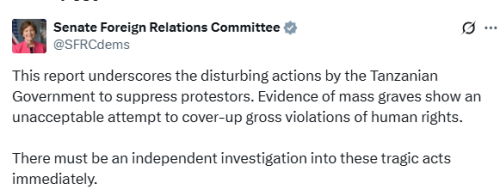
“This report underscores the disturbing actions by the Tanzanian Government to suppress protestors. Evidence of mass graves shows an unacceptable attempt to cover up gross violations of human rights,” the Committee said in a statement on X on Tuesday, November 25, 2025. “There must be an independent investigation into these tragic acts immediately.”
Earlier, US Senators Jim Risch and Jeanne Shaheen warned that Tanzania’s post-election violence poses a growing threat not only to its citizens but also to neighbouring countries, including Kenya and the wider East African region. They condemned state-sponsored political repression, abductions, and widespread intimidation, and highlighted that internet shutdowns during the elections left millions of Tanzanians isolated.
“Tanzania’s ruling party has created an environment of fear that challenges the security of the country and neighbouring countries,” the senators said, stressing that Washington was closely monitoring the regional impact of the crisis.
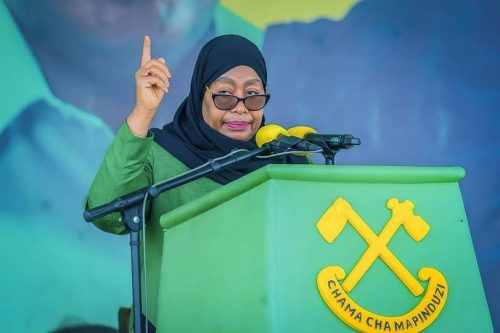
The violence erupted after President Samia Suluhu Hassan was re-elected with 98 per cent of the vote in elections marked by the exclusion of key opposition candidates. Citizens across the country took to the streets to protest what they described as a rigged poll.
Authorities responded with curfews, internet blackouts, and heavy policing. CNN’s report showed mortuaries overwhelmed with bodies, hospitals treating victims with gunshot wounds, and security forces operating alongside plainclothes officers.
Also watch: Amnesty International sounds alarm over escalating repression in Tanzania.
Govt rejects report
The Tanzanian government has rejected the findings, calling the report biased and aimed at destabilising the country. Government spokesperson Gerson Msigwa accused CNN and other international outlets of relying on unverified social media and satellite imagery without seeking the authorities’ side of the story.
“Professional journalism requires fairness and accountability. Publishing information without seeking the government’s perspective is unprofessional,” Msigwa said. He also stressed that the ongoing government inquiry should not be interfered with by foreign media.
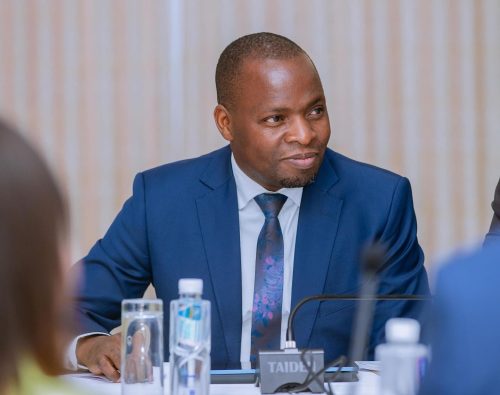
President Suluhu has launched a national Commission of Inquiry, chaired by retired Chief Justice Mohamed Chande, to investigate the unrest. The commission aims to establish the causes of the protests, the role of political parties, and the involvement of local and foreign actors.
During its launch, the president suggested that some youths had been paid to take part in the protests, raising questions about external influence.
Despite this, critics, including Tanzania’s main opposition party, CHADEMA, insist that only an independent international probe can provide accountability.
CHADEMA Secretary General John Mnyika called on the United Nations and the International Criminal Court (ICC) to investigate what the party describes as mass killings by security forces. The UN Human Rights Office has indicated that hundreds of civilians and protesters may have died, with many more injured or detained during the unrest.
The aftermath of the election has also affected national events and the economy. Tanzania announced the cancellation of this year’s Independence Day celebrations on December 9, with funds originally intended for the festivities redirected to repair infrastructure damaged during post-election protests.
Roads, public buildings, police stations, and commercial centres suffered significant destruction, disrupting trade and informal economic activities that support much of the population.
Author
Kenneth Mwenda
Kenneth Mwenda is a business, sports, and politics digital writer with over seven years of experience in journalism, covering breaking news, feature stories, and in-depth analysis across a range of beats.
For inquiries, he can be reached at [email protected]
View all posts by Kenneth MwendaLatest News



Advertisement
More on News