US Congress seeks sanctions on govts facilitating Russia’s recruitment of Africans
By Aloys Michael, June 17, 2026African governments could face sanctions from the United States if they are found to be facilitating, benefiting from, or turning a blind eye to the recruitment of their citizens into Russia’s war against Ukraine under a new bill introduced in the US Congress.
The proposed legislation, dubbed the Countering Russia’s Forced Recruitment and Kidnapping in Africa Act, marks a significant escalation in Washington’s efforts to disrupt Moscow’s recruitment networks across Africa and signals growing concern over reports that Africans are being lured into the conflict through deception and false promises.
Introduced in the US House of Representatives, the bill seeks to impose sanctions not only on individuals involved in recruitment schemes but also on foreign governments found to be participating in or facilitating the enlistment of African nationals for Russia’s war effort.
The move places several African countries under fresh scrutiny, including Kenya, South Africa and Cameroon, which are cited in the legislation as locations where recruitment networks have targeted vulnerable citizens.
“Russian-backed entities are working to recruit civilian and military personnel across the African continent to participate in Russia’s illegal war against Ukraine,” the bill states.
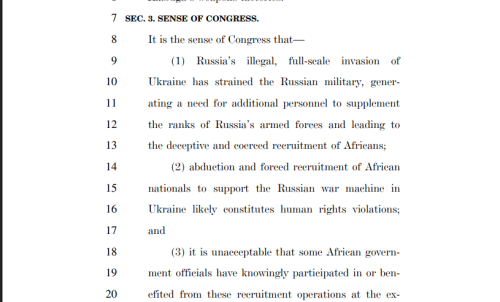
According to the legislation, the Ukrainian government has reported that more than 1,400 citizens from 36 countries across Africa are fighting alongside Russian forces in Ukraine.
“Africans are regularly referred to as ‘expendable’ and ‘cannon fodder’ by Russians in the conflict areas,” the bill reads, citing reports that some recruits have been forced into the most dangerous combat positions.
While much attention has focused on individual recruiters, the legislation’s most consequential provision targets governments accused of enabling such operations.
“It is unacceptable that some African government officials have knowingly participated in or benefited from these recruitment operations at the expense of their citizens,” the bill states.
The language signals a growing willingness by Washington to hold governments accountable for failing to dismantle recruitment networks operating within their borders.
Under the proposed law, the US Secretary of State would be required to create a list of foreign persons and foreign governments found to be participating in or facilitating the recruitment of Africans for Russia’s military operations in Ukraine.
The legislation specifies that the list would include entities involved in recruiting Africans who knowingly or unknowingly join the Russian military, Russia-aligned organisations, or accept employment under false pretences that ultimately support the Russian war effort.
Those placed on the list could face a broad range of sanctions as the bill authorises measures including the freezing of assets under US jurisdiction, denial of access to American financial institutions, opposition to international loans, procurement restrictions and visa bans.
Washington would also be empowered to oppose loans from international financial institutions that benefit sanctioned governments or individuals.
The legislation comes as concerns mount over Russia’s recruitment activities across Africa.
Lawmakers cited multiple cases in which victims were promised employment, educational opportunities or professional training before being diverted into military service.
One of the examples highlighted in the bill involves Kenya, where more than 20 men were rescued from a suspected human trafficking network in Nairobi in September 2025 after being reported to have been promised jobs in Russia before being prepared for deployment to Ukraine.
The bill also references reports from Cameroon, where local recruitment networks have been used to funnel individuals into Russia’s military ranks.
The proposal reflects broader geopolitical tensions between Washington and Moscow as both powers compete for influence across Africa.
For African governments, the legislation creates a new diplomatic challenge. Countries that have sought to maintain neutral positions on the Ukraine conflict may increasingly find themselves under pressure to demonstrate that they are actively combating recruitment and trafficking networks linked to Russia.
Should the bill become law, African governments would face a stark choice: aggressively crack down on recruitment operations or risk being swept into a US sanctions regime designed to choke off one of Russia’s most controversial sources of manpower for the war in Ukraine.