Advertisement
Ruto’s govt under pressure as US Congress targets Kenya over Russia war recruitment
Wednesday 17th June, 2026 06:16 AM|

President William Ruto’s administration is facing growing international scrutiny after the United States Congress moved to crack down on the recruitment of Africans, including Kenyans, into Russia’s war against Ukraine, raising questions about Nairobi’s response to an escalating human trafficking and security crisis.
The pressure comes after the introduction of the Countering Russia’s Forced Recruitment and Kidnapping in Africa Act in the US House of Representatives, a bill that seeks to sanction foreign individuals and governments found to be participating in or facilitating the recruitment of Africans for Russia’s military campaign in Ukraine.
Although the proposed legislation does not directly name Kenya as a target for sanctions, lawmakers singled out the country multiple times, citing cases of deception, trafficking and recruitment networks operating within its borders.
The bill paints a disturbing picture of how vulnerable Africans are being lured into the conflict through false promises of jobs, training opportunities and sports contracts before being forced onto the battlefield.
You Might Also Like


“Russian-backed entities are working to recruit civilian and military personnel across the African continent to participate in Russia’s illegal war against Ukraine,” the bill states.
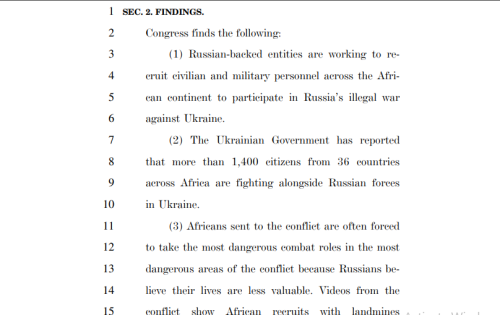
It further notes that more than 1,400 citizens from 36 African countries are reported to be fighting alongside Russian forces.
US lawmakers referenced a September 2025 operation in Nairobi in which more than 20 Kenyan men were rescued from a suspected human trafficking ring.
According to the bill, the men had been promised employment opportunities in Russia but were instead being prepared for deployment to the war in Ukraine.
The legislation also recounts the experience of Kenyan long-distance runner Evan Kibet, who is said to have travelled to Russia after being promised participation in athletic competitions.
“An agent offered to fly him and three other Kenyans to St. Petersburg for races. There, he was told to sign work papers in Russian, and told if he did not sign, he would be killed. He was then sent to a military camp,” the bill says.
Significantly, US lawmakers acknowledged that Kenyan authorities are aware of the problem. The bill cites Kenya’s Foreign Ministry, which described Kremlin-linked recruiters as ruthless operators who trick young men with false job offers.

According to the legislation, Kenyan officials have warned that recruiters masquerade as individuals connected to the Russian government and use falsified information to lure unsuspecting victims.
However, despite the arrests of a Russian Embassy employee and a Kenyan accomplice in Nairobi in September 2025 over claimed recruitment activities, concerns remain about the effectiveness of Kenya’s response.
The bill’s language suggests growing frustration among US lawmakers over governments that fail to dismantle recruitment networks or protect their citizens from exploitation.
“It is unacceptable that some African government officials have knowingly participated in or benefited from these recruitment operations at expense of their citizens,” the legislation states.
That provision is particularly significant because the proposed law empowers the US Secretary of State to compile a list of foreign persons and governments found to be participating in or facilitating such recruitment.
Those listed could face a raft of sanctions, including asset freezes, restrictions on access to US financial institutions, opposition to international loans, procurement bans and visa prohibitions.

Kenya-US ties
The legislation also directs the US government to deny visas and revoke existing travel documents for individuals implicated in recruitment schemes.
For Kenya, the bill arrives at a sensitive diplomatic moment. Nairobi remains one of Washington’s closest allies in Africa and recently secured major non-NATO ally status from the United States.
Yet the congressional move signals that America expects stronger action against trafficking networks feeding Russia’s war machine.
The issue also exposes a broader challenge facing Kenya: rising youth unemployment and economic hardship have made many young people vulnerable to fraudulent overseas job offers.
By placing Kenya alongside other African countries cited in recruitment cases, US lawmakers are effectively sending a warning that failure to aggressively investigate recruiters, rescue victims and prevent future recruitment could attract greater international scrutiny.
As the legislation advances through Congress, the spotlight will increasingly fall on the Ruto administration and whether it can demonstrate that Kenya is part of the solution rather than a transit point for one of Russia’s most controversial recruitment pipelines.
Author
Latest News








Advertisement
More on News