UNEP calls for urgent action to protect freshwater ecosystems
By Faith Lagat, August 24, 2025As World Water Week 2025 kicks off on Sunday, August 24, 2025, the United Nations Environment Programme (UNEP) is sounding the alarm on the dire state of freshwater ecosystems, urging immediate global action to safeguard these critical resources.
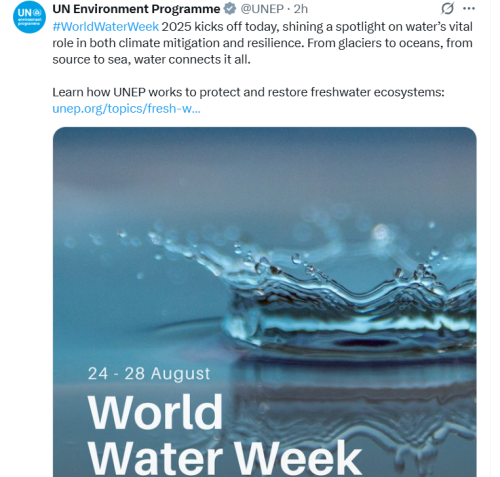
The event, running from August 24 to 28, spotlights water’s indispensable role in climate mitigation and resilience, connecting ecosystems from glaciers to oceans. “#WorldWaterWeek 2025 kicks off today, shining a spotlight on water’s vital role in both climate mitigation and resilience. From glaciers to oceans, from source to sea, water connects it all,” read a post by UNEP dated August 24, 2025.
Freshwater ecosystems, including rivers, lakes, wetlands, and aquifers, are facing unprecedented threats, despite being vital for sustaining life and combating biodiversity loss, pollution, and climate change. UNEP emphasised their centrality, stating that “Freshwater ecosystems underpin all human social and economic activity. They are vital for supporting the web of life on Earth and need to be valued, conserved, and restored.”
Human rights at risk
The urgency is heightened by UNEP’s warning that while access to sufficient, safe, and reliable fresh water is a human right, the ecosystems that provide it are under increasing threat. Its Freshwater Strategic Priorities, aligned with the Medium-Term Strategy 2022–2025, position these ecosystems as essential to confronting the triple planetary crisis.
“While access to fresh water, in sufficient quantity, quality, and availability, underpins human life, health, well-being, and dignity and is a human right, the ecosystems that provide this fresh water are under increasing threat,” UNEP cautioned.
Kenya’s local push
The global call resonates locally through the Lake Victoria West Water and Sanitation (LVWATSAN) programme in Kisumu, a Ksh10.6 billion investment aimed at expanding water access and sanitation. Overseen by the Kisumu Water and Sanitation Company (KIWASCO), the initiative targets 25,000 household water connections and 1,700 homes linked to sewerage systems.
Governor Peter Anyang’ Nyong’o hailed the project as a lifeline. “Access to safe water and proper sanitation is a fundamental human right. Kisumu deserves nothing less,” he posted on July 25. The programme also includes reducing water loss to 28 per cent and constructing 4,968 affordable housing units.
However, community resistance in Otonglo threatens the construction of a critical sewerage treatment plant. “We must work together to resolve this impasse. The plant is essential for the future sustainability of Kisumu’s sanitation systems,” Nyong’o warned.
Cabinet Secretary for Water, Sanitation and Irrigation, Eric Murithi Mugaa, echoed the urgency while handing over equipment to KIWASCO. “This equipment is not symbolic; it’s strategic. It will help us detect and address inefficiencies in our system,” he said.
As demand for water grows, UNEP’s global appeal and Kisumu’s local initiatives highlight a shared imperative. “Water is the next frontier of development. We cannot afford to let misinformation or fear stand in the way,” Nyong’o concluded.