UN: 5G to cover half the world by 2025, but digital divide persists
By Faith Lagat, August 24, 2025The United Nations has sounded the alarm over uneven progress towards bridging the global digital divide, even as 5G technology is set to cover more than half of the world’s population by the end of 2025.
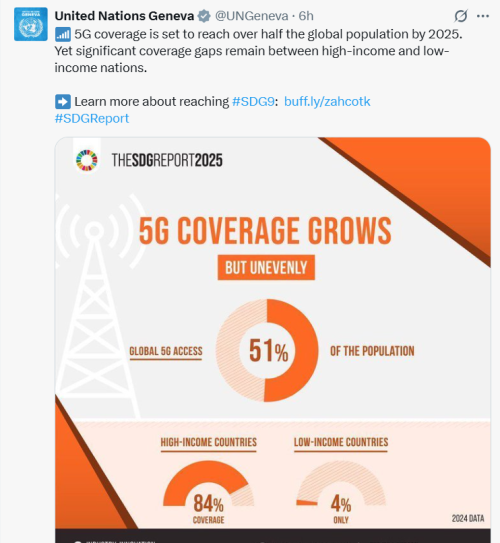
A key highlight from the UN Geneva underscores this uneven progress, revealing that significant coverage gaps remain between high-income and low-income nations.
“5G coverage is set to reach over half the global population by 2025. Yet significant coverage gaps remain between high-income and low-income nations,” read a UN Geneva post dated August 24, 2025.
The Sustainable Development Goals (SDG) Report 2025, released on July 14, shows notable advances since 2015, including universal electricity access in 45 countries, improved maternal and child health, and renewable energy becoming the fastest-growing power source.
But the report warns that millions remain trapped in poverty, hunger and poor access to essential services, with conflicts, climate change and inequalities slowing momentum.
A UN Geneva statement on August 24 highlighted the divide in digital connectivity, noting that while 84 per cent of the population in high-income countries enjoys 5G access, only four per cent in low-income nations are covered. The imbalance, the report cautions, threatens to deepen economic and educational inequalities unless urgent corrective action is taken.
Kenya’s digital push
In Kenya, President William Ruto has placed digital transformation at the centre of his administration’s agenda. During the EU-Kenya Business Forum on May 12 in Nairobi, he announced plans to install 25,000 public Wi-Fi hotspots by 2027 as part of a last-mile fibre connectivity project targeting 100,000 kilometres of fibre optic cable.
The Head of State also highlighted the digitisation of over 20,000 government services through the eCitizen platform and the rollout of 284 digital hubs in technical training institutions, with 400 more under construction. These centres have already drawn global technology firms, including Microsoft, Apple and business outsourcing companies such as CCI, positioning Kenya as an emerging digital hub in the region.
Challenges
However, the country’s digital journey has faced setbacks. A flagship campaign pledge by President Ruto in 2022 to provide free Wi-Fi in public spaces has struggled to materialise. The project, initially allocated Sh38 billion with a pilot launch expected in November 2022, has been slowed by economic pressures, including mounting public debt, which surpassed 70 per cent of GDP by 2024.
Funds were diverted to healthcare and recovery efforts following the June 2024 anti-tax protests, while technical delays and claims of graft have further derailed implementation.
Reports from traders in markets such as Gikomba and Kisumu indicate that installed hotspots remain inconsistent or non-functional. According to an Afrobarometer 2024 survey, 67 per cent of Kenyans expressed dissatisfaction with government economic management, reflecting growing frustration over unmet digital promises.
Call for transparency
European Union Ambassador to Kenya Henriette Geiger reaffirmed the EU’s commitment to supporting digital trade, announcing the launch of EuroCham Kenya to strengthen partnerships in customs technology, artificial intelligence and fintech.
Even as community-led solar-powered internet kiosks provide some hope for connectivity in underserved regions, experts have urged transparency in government projects, including a public audit of the Sh38 billion Wi-Fi programme, to restore trust and ensure inclusivity in Kenya’s digital growth.
As the UN report underscores, the race to achieve the SDGs by 2030 hinges on narrowing divides—digital or otherwise—before they harden into permanent fault lines.