Trump announces US Navy blockade in Strait of Hormuz after Iran talks stalemate
By Kenneth Mwenda, April 12, 2026US President Donald Trump has ordered the navy to begin a blockade of the Strait of Hormuz, marking a sharp escalation in tensions with Iran after peace talks collapsed.
In a post on Truth Social on Sunday, April 12, 2026, Trump said the United States would stop all ships entering or leaving the narrow waterway, which is one of the world’s most important routes for oil transport. He framed the move as a response to what he called Iranian “extortion”.
“Effective immediately, the United States Navy… will begin the process of BLOCKADING any and all ships trying to enter, or leave, the Strait of Hormuz,” Trump wrote.
The decision came just hours after talks between US and Iranian officials in Pakistan ended without agreement. The negotiations had lasted more than 20 hours but broke down over key issues, including Iran’s nuclear programme and control of the strait.
The direct talks on Saturday involved US Vice President JD Vance, special envoy Steve Witkoff and Donald Trump’s son-in-law Jared Kushner, alongside Iranian Parliamentary Speaker Mohammad Baqer Ghalibaf and Foreign Minister Abbas Araghchi. Pakistan’s army chief also attended.
Saturday marked the first direct talks between the United States and Iran since the 1979 Islamic Revolution. Before this, the highest-level contact was in 2013, when former US President Barack Obama held a phone call with Iranian President Hassan Rouhani to discuss the nuclear programme
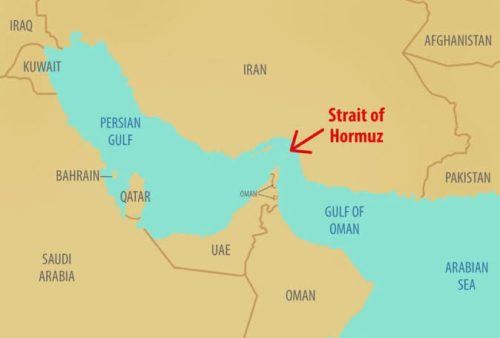
The Strait of Hormuz sits between Iran and the Gulf states and carries about a fifth of the world’s oil supply. In recent weeks, shipping through the route has slowed sharply due to fears of attack and reports of sea mines. Energy markets have already felt the impact, with fuel prices rising in several countries.
Trump accused Iran of using the threat of mines to control access.
“Iran has not allowed that to happen by merely saying, ‘There may be a mine out there somewhere,’ that nobody knows about but them,” he said.
He added:
“This is world extortion… and leaders… will never be extorted.”
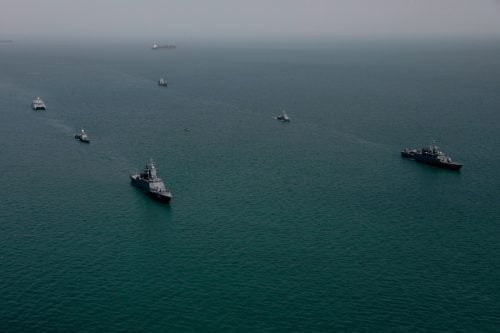
US military activity in the area had already increased before the announcement. Officials confirmed that navy destroyers had entered the strait and begun mine-clearing operations. Additional forces, including underwater drones, are expected to join in the coming days.
Tensions rise
Trump also, on April 11, claimed that Iranian mine-laying vessels had already been destroyed.
“All 28 of Iran’s mine dropper boats are also lying at the bottom of the sea,” he wrote. However, Iranian media rejected this claim and described it as false.
The blockade is expected to go further than mine-clearing. Trump said US forces would “seek and interdict” any vessel that had paid a toll to Iran to pass through the strait.
“No one who pays an illegal toll will have safe passage on the high seas,” he said.
He also warned of a strong military response to any attack.
“Any Iranian who fires at us, or at peaceful vessels, will be blown to hell,” he wrote.
Iran’s Revolutionary Guards responded with their own warning, saying they would act against foreign military ships entering the waterway. They insisted they had the authority to manage passage through the strait and suggested access would be limited.
“Any attempt by military vessels to pass through the Strait of Hormuz will be dealt with severely. The IRGC Navy has full authority to manage the Strait of Hormuz intelligently,” the Guards’ Navy Command said in a statement released through state broadcaster IRIB, AFP reported.
The collapse of talks has left a fragile ceasefire in doubt. The two sides had agreed to pause fighting for two weeks, but without a deal, there are fears the conflict could resume.
According to sources briefed on the negotiations, Iran refused to give up its enriched uranium stockpile and insisted on maintaining control over the strait. These demands proved unacceptable to the US side.
Trump repeated his hard line on Iran’s military position, claiming its forces had already been weakened. “Their Navy is gone, their Air Force is gone,” he said, adding that Iran’s defences were “useless”.
He also suggested that more military action could follow. “At an appropriate moment, we are fully ‘locked and loaded’,” he said.
The situation has raised concerns among global leaders, as any disruption to the Strait of Hormuz could have wide economic effects. Oil shipments have already slowed, and analysts warn it could take months for normal traffic to resume even if tensions ease.
For now, the focus remains on the US navy’s next steps. Trump said the blockade would begin “shortly” and hinted that other countries could join the operation.
“Other countries will be involved with this blockade,” he wrote, without giving details.
With both sides issuing threats and no agreement in place, the risk of further escalation remains high.