A new TIFA national survey shows that taxation has become the most serious concern for Kenyans, ahead of other economic pressures such as inflation, unemployment, and the rising cost of living.
The report was released on June 4, 2026, while the findings are based on a nationwide study of 2,013 adults across all 47 counties, conducted between 2 and 11 May 2026.
The survey paints a clear picture of a population under economic strain. It shows that tax policy is now viewed more negatively than any other government performance area, making it the strongest driver of public dissatisfaction.
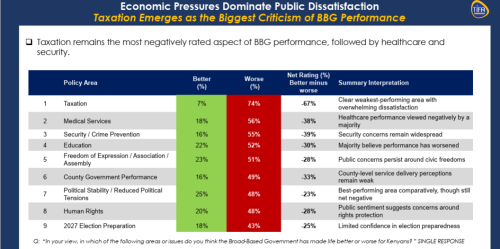
According to the report, when Kenyans were asked to assess government performance across key sectors, taxation stood out sharply. Only 7 per cent said it had made life better, while 74 per cent said it had made life worse. The survey concludes that taxation is “the clear weakest-performing area with overwhelming dissatisfaction.”
This result places taxation well below other sectors such as medical services, security, and education, all of which also recorded negative ratings. However, none came close to the level of discontent seen in tax policy.
One section of the report states clearly:
“Taxation remains the most negatively rated aspect of BBG performance.”
Part of the TIFA report. PHOTO/Screengrab by People Daily Digital
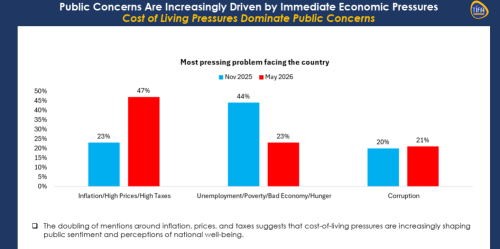
The survey also shows that economic hardship is widespread and deeply felt. When asked what the most serious problem facing the country is, 47 per cent of respondents pointed to inflation, high prices, or high taxes. A further 23 per cent mentioned unemployment, poverty, or a weak economy. This means 70 per cent of Kenyans see economic issues as the country’s biggest challenge.
As the report notes:
“Inflation/High Prices/High Taxes” dominate public concern, followed by unemployment and poverty.
This indicates that taxation is not seen in isolation but as part of a wider cost-of-living crisis. For many households, rising taxes are experienced alongside high food prices and transport costs, reducing disposable income and worsening financial pressure.
Part of the TIFA report. PHOTO/Screengrab by People Daily Digital
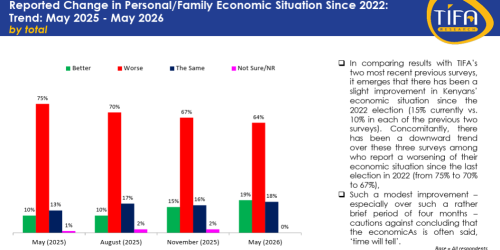
Economic hardship appears to be closely linked to this outlook. Many respondents reported that their personal financial situation has worsened since the last election in 2022. The report states that about two-thirds of Kenyans (64 per cent) say they are worse off, compared to 19 per cent who feel better off.
Part of the TIFA report. PHOTO/Screengrab by People Daily Digital
The study also highlights how taxation affects trust in government performance. Across multiple institutions, negative trust levels are higher than positive ones. Parliament, the police, and the presidency all record more distrust than confidence. This suggests that dissatisfaction with taxation feeds into a broader lack of confidence in governance.
Despite differences in political opinion, concern over taxation cuts across groups. Even among supporters of the Broad-Based Government arrangement, dissatisfaction remains high. The survey notes that economic pressure influences both supporters and opponents, although opponents are generally more critical.
The report also links taxation to perceptions of fairness and economic survival. Rising prices, especially for food and transport, are mentioned frequently alongside tax concerns. Many respondents believe government revenue measures are increasing pressure on households already struggling with inflation.
As the report puts it, economic pressures are increasingly shaping public views:
“Cost-of-living pressures are increasingly shaping public sentiment and perceptions of national well-being.”