Advertisement
State disburses Sh1.2b relief to hunger-stricken families
Wednesday 29th June, 2022 12:00 AM|
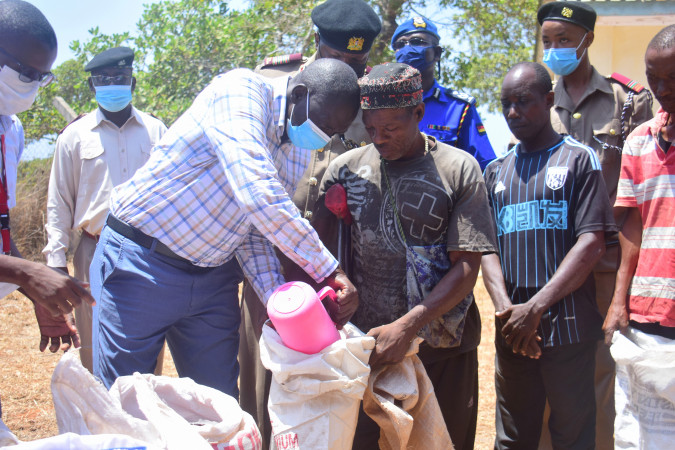
The Government has disbursed Sh1.1 billion for poor and vulnerable households in Marsabit, Wajir, Mandera and Turkana to cushion them against drought shocks.
The money is being disbursed through the National Drought Management Authority (NDMA), under the Hunger Safety Net Programme (HSNP).
Yesterday, the authority’s Chief Executive Officer, Lieutenant-Colonel (Rtd) Hared Hassan Adan said the cash transfers are being disbursed to beneficiaries based on certain thresholds of the Vegetation Condition Index (VCI).
Raised to 50pc
“When the drought is severe in a given sub-county, an additional 25 per cent of households registered in the HSNP database are on-boarded to benefit from the stipend. And if the VCI shows that drought is in the extreme phase, the number of beneficiaries is raised to 50 per cent of the registered households,” said Adan.
Beneficiaries will begin receiving payments today, through Equity Bank agents and branches in their regions.
He said NDMA has disbursed Sh638.6 million under the drought shock responsive cash transfer portfolio to an additional 58,000 households in the four counties.
NDMA has also disbursed over Sh500 million under the routine cash transfer segment to over 91,000 beneficiaries.
He said the disbursements under HSNP are part of the Kenya Social and Economic Inclusion Project (KSEIP). Each household under the HSNP routine segment, commonly referred to as Group 1 Beneficiaries, is entitled to Sh5,400, while those under the shock-responsive portfolio receive Sh2,700,” said Adan.
Mandera and Marsabit, which have 19,000 and 18,000 beneficiaries each, will receive Sh108 million and Sh101 million, respectively, while Wajir county with over 17,000 beneficiaries receives Sh95 million.
Turkana County has the highest number of beneficiaries, at over 35,000. It has received Sh195 million in the HSNP routine.
The four counties are among those hardest hit by drought after four consecutive failed seasons, undermining livelihoods and community coping mechanisms.
Adan said drought has continued to worsen in 19 of 23 ASAL counties. This is attributed to poor performance of the 2021 short rains, coupled with two failed consecutive seasons and early cessation of the 2022 long rains season. People in need of assistance have increased from 3.5 million in May to 4.1 million this month.
Six counties — Laikipia, Mandera, Marsabit, Wajir, Isiolo and Samburu — are in ‘alarm’ drought phase while 13 counties, including Kilifi, Turkana, West-Pokot, Kwale, Meru (North), Embu (Mbeere), Garissa, Kajiado, Kitui, Nyeri (Kieni), Taita-Taveta, Tharaka-Nithi and Tana-River are in ‘alert’ drought phase. Four counties — Baringo, Lamu, Narok and Makueni — are in ‘normal’ drought phase.
Sh2.6 billion disbursed
Acute malnutrition has also been noted across the counties, with 942,000 cases of children aged 6-59 months acutely malnourished and 134,000 cases of pregnant or lactating women acutely malnourished.
Since last September, he said, the government has disbursed over Sh2.6 billion under HSNP and another Sh8.58 billion for the elderly, orphans, vulnerable children and people living with severe disabilities.
The government has stepped up drought response across the 23 counties, spending over Sh4.9 billion in food aid, Sh500 million for commercial livestock off-take in 13 counties, in addition to water trucking and fuel subsidy to strategic boreholes. A further Sh1.1 billion has been disbursed as emergency relief to 170,940 households.
Author
Irene.Githinji
View all posts by Irene.GithinjiLatest News






Advertisement
More on News