Senator Chesang calls for urgent action as failed rains destroy Trans Nzoia crops
By Sharon Atieno, June 21, 2026Trans Nzoia Senator Allan Chesang has called for urgent government action after failed rains wiped out crops across Trans Nzoia, leaving farmers facing heavy losses, rising debt, and growing food insecurity.
In a statement on Sunday, June 21, 2026, the senator warned that climate change is already hitting farmers hard, stressing that those who planted in hope are now counting losses as unpredictable weather continues to destroy livelihoods across the county.
“Our farmers in Trans Nzoia feed Kenya. Right now, they face serious losses as failed rains destroy crops they’ve planted with hope and debt,” Chesang said.
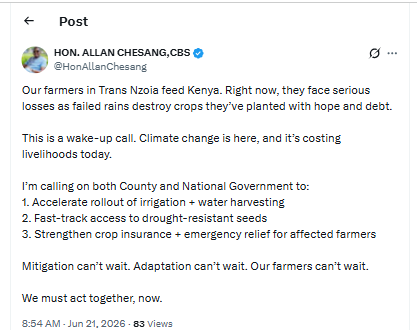
He urged both the County and National Governments to urgently roll out irrigation and water harvesting systems to reduce overreliance on rain-fed agriculture, which he said is no longer dependable.
The senator also pushed for fast-tracking access to drought-resistant seeds, saying farmers need climate-smart solutions that can withstand prolonged dry spells and erratic rainfall.
Push for stronger farmer protection systems
Chesang further called for the strengthening of crop insurance schemes and emergency relief support to cushion farmers who are already counting losses from failed harvests.

He stressed that without urgent intervention, many farmers risk sinking deeper into debt due to investments in seeds, labour, and farm inputs that are now being lost to climate shocks.
Climate change warning grows louder
The senator noted that climate change adaptation cannot be delayed, insisting that mitigation measures must be implemented immediately to protect food production and rural livelihoods.
“Mitigation can’t wait. Adaptation can’t wait. Our farmers can’t wait. We must act together, now,” he added.
Experts back shift to irrigation farming
His remarks come amid growing expert calls for a transition from rain-fed agriculture to irrigated farming systems.
Agricultural experts have warned that continued reliance on rainfall is no longer sustainable, with some counties already experiencing repeated crop failures linked to prolonged droughts and erratic weather patterns.
They argue that irrigation, water harvesting, and climate-resilient farming practices are key to securing long-term food production and stabilising rural incomes.
Budget support and policy focus
The concerns also come as the government continues to retain major agricultural support programmes in the 2026/27 budget, including fertiliser subsidies aimed at boosting productivity and supporting farmers across the country.
Officials say such interventions are part of broader efforts to strengthen food security and protect farmers from climate-related shocks, even as pressure mounts for more structural reforms in the agriculture sector.