Advertisement
Season of turmoil: Businesses looted as unrest hits Mt Kenya
Wednesday 09th July, 2025 02:40 AM|

A dramatic political shift is unfolding as the traditionally conservative Mt Kenya region becomes the new epicentre of street demonstrations, overshadowing the long-standing protest strongholds of Nyanza and Western counties.
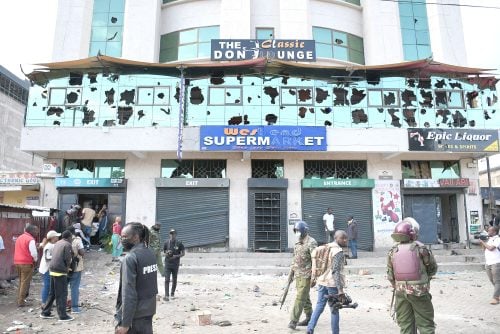
The protests have devastated local businesses, with major retail chains including Naivas, Maguna Andu, Quickmart, CleanShelf and Stagematt suffering break-ins and massive looting across Central region towns. Goods worth millions of shillings were stolen from their franchises.
Regional leaders have condemned the violent protests, warning they risk driving the area into economic ruin. Investments, Trade and Industry Cabinet Secretary Lee Kinyanjui became the latest leader to castigate the perpetrators, calling their actions “defeatist and retrogressive”.
“My heart bleeds for the many businesses that were vandalised, looted, and burned down. Thousands now have no place to report to work or sell their wares. This is both defeatist and retrogressive,” Kinyanjui said.
‘Worsening the problem’
You Might Also Like



The former Nakuru governor warned residents they cannot sacrifice businesses and terminate jobs to protest the cost of living, as this only worsens the problem. “We have added more people to the jobless bench. Anarchy is not the panacea to the challenges our society faces,” the CS said.
Former Kirinyaga senator Charles Kibiru called the property destruction “uncalled for”, adding that youth can hold peaceful demonstrations without targeting business premises.
“They should not destroy properties because they will affect the same businesses that should be employing them. I also want to imagine it is not instigated to isolate the community for political reasons,” Kibiru said.
Kibiru warned that the entire country faces a “time bomb” over the large number of educated but unemployed youth with internet access.
“Kenya has so many idle young people who are educated but unemployed. Lack of something to do is causing an increase in activism in these regions,” he said.
He rejected impressions that the political class has created among Kenyans that the Central region is marginalised as the new opposition backyard, leading to intense protests against the government.
Kibiru noted that regions previously synonymous with protests have stepped back from the streets because their ringleaders now occupy the inner circle of the Kenya Kwanza government.
Raila-Ruto pact
During Energy Cabinet Secretary Opiyo Wandayi’s homecoming in Ugunja, Siaya County, last August, President William Ruto vowed to pull the region from opposition into government.
Ruto, who had begun enjoying support from regional kingpin Raila Odinga following anti-government Gen Z protests, called on residents to support his government.
“[Do] you agree that after three years we should hand over the opposition to other people? Or do you still want the Nyanza region to continue being in opposition? If there are people who want to lead the opposition, let us give it to them,” Ruto said.
However, Kibiru maintained that Nyanza cannot be considered fully in government, adding that the Raila-Ruto pact will face its real test approaching the 2027 general election when political realignments take shape.
Selfish interests
Political analyst Javas Bigambo accused politicians of hijacking Gen Z protests to advance selfish interests and divert the initial agenda of calling for good governance and accountability.
“Politicians are now exerting their own influence in the protests, whether they are from the government side or the opposition side. The cause that Gen Z started has been stopped and replaced with another by the political class,” Bigambo said.
According to Bigambo, the Mt Kenya region hasn’t been driven to opposition by virtue of not being in government.
“The government belongs to everybody, despite who they voted for and as long as they are paying taxes. The Constitution does not have a provision for opposition anywhere. It only creates majority and minority sides. So we don’t have opposition in Kenya,” he said.
He cautioned that leaders categorising regions as opposition or government territory likely exacerbates community tensions, fuelling animosity that makes protests more violent.
“It is not right to say that some people should be in a government and others in opposition. That creates the perception of us versus them mentality,” Bigambo emphasised.
Season of turmoil
With politicians positioning themselves to garner support from the party-less Gen Z by diverting their governance calls to serve political interests, Bigambo warned the country is heading towards a season of turmoil.
“We are finding ourselves in a very volatile state of politics – politics that is fragile. And already it is pointing to very serious violence or potential violence in 2027,” he said.
Citing violence during youth-led protests, Bigambo faulted the political class for failing to order sobriety among youthful supporters, resulting in economic crimes.
“As young people are pushing for social justice and accountability, other rogue elements have been infiltrating the demonstrations to loot, cause mayhem among well-meaning protesters and burn buildings. They are no longer operating within the realm of law,” he said.
He called on government institutions to crack down on the masterminds of the new Gen Z protest phase, likely to spur civil strife ahead of the 2027 elections.
“The inciters and some financiers of all these destruction and mayhem must be apprehended and even charges pressed against them in the courts of law,” Bigambo said.
‘Sponsored demos’
During Monday’s running battles between police and protesters, claims emerged that demonstrators had been sponsored to cause chaos and loot businesses.
In major Murang’a urban centres, residents reported seeing unfamiliar faces from early morning, suspected of being “hired” to cause chaos.
Allegations surfaced of pro-government leaders distributing money for mobilisation to bring more youth to the streets.
Acting Central Regional Commissioner Joshua Nkanatha, who doubles as Murang’a county commissioner, said police are investigating the matter.
“This is something we are also going to investigate to establish if we had people from outside who had been ferried to this area,” he said.
Massive property destruction, deaths, and scores of injuries characterised the regional demonstrations. Police continued chasing protesters in running battles on the outskirts of Murang’a town past midnight Monday.
Nkanatha assured residents that security agents would track down all those involved in looting and property destruction.
“People will learn to respect the law and we will make sure we nab all the culprits involved in the destruction of property,” he said.
“The police did a good job in controlling the demonstrators because the damage could have been more intense.”
Deaths and injuries
Kangema MP Peter Kihungi claimed the area’s first-ever protests were led by outsiders.
He said goons had been mobilised by someone from within the area, initially targeting businesses before turning to vandalising market construction materials and later moving to the police station.
“In the process, two people were shot dead, and I want to tell those doing this to know they won’t rise to power using the blood of the people,” said Kihungi.
“The area was very peaceful since morning and these people came in the evening, which indicates someone sent them.”
Four people were shot dead during the Murang’a protests – two from Kangari in Kigumo and two from Kangema – along with scores of civilians and police officers injured.
Health Director James Mburu said two patients were recuperating in the ICU in stable condition.
Annabel Njambi, proprietor of County Supermarkets, said the destruction was clearly planned, with looters having a dress code for identification.
“I identified one of the team leaders who was a former employee and she was the one directing them on what to do, which clearly indicates they were on a mission and someone had sent them,” said Njambi.
Author
Samuel Kariuki
View all posts by Samuel KariukiLatest News




Advertisement
More on News