School feeding programme hit by Ksh6.6B shortfall
By Faith Lagat, April 3, 2026The National Council for Nomadic Education in Kenya (NACONEK) is grappling with a severe funding crisis that threatens the school feeding programme, putting thousands of vulnerable learners at risk of dropping out.
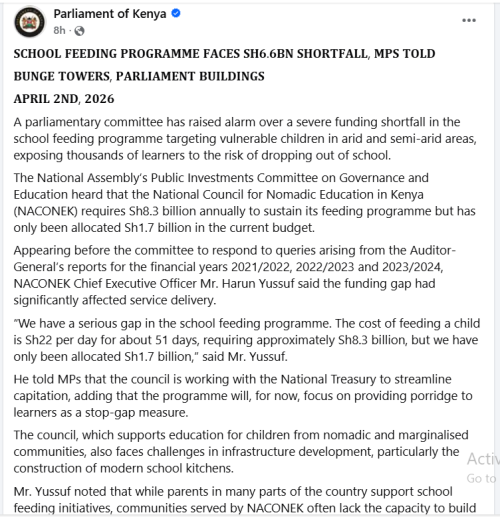
On April 2, 2026, the National Assembly’s Public Investments Committee on Governance and Education was informed that NACONEK requires about Ksh8.3 billion annually to run the programme effectively but has been allocated only Ksh1.7 billion in the current budget.
“We have a serious gap in the school feeding programme. The cost of feeding a child is Ksh22 per day for about 51 days, requiring approximately Sh8.3 billion, but we have only been allocated Ksh1.7 billion,” NACONEK Chief Executive Officer Harun Yussuf said.
He said the shortfall of Ksh6.6 billion has forced the council to scale down operations and provide porridge as a temporary measure, while working with the National Treasury to streamline capitation.
Marginalised learners bear the brunt
The programme mainly targets children in arid and semi-arid lands (ASALs) and nomadic communities, where school meals serve as a critical incentive for enrolment and retention.
Without sufficient food, learners from these areas often miss classes or drop out, reversing gains in access to basic education.
Irregular disbursement of funds, highlighted by the Auditor-General, has worsened the situation, with some schools going months without supplies.
Infrastructure challenges further impede the programme. NACONEK struggles to construct modern school kitchens, as communities in these regions cannot contribute.
While the council has piloted clean energy cooking in a few schools and plans to expand to 14 more, budget constraints remain a barrier. “It is the responsibility of government to establish kitchens at school level, but we do not have the budget for that, Yussuf said.
Lawmakers call for urgent action
Members of Parliament expressed concern over the plight of the affected communities. Narok Woman Representative Rebecca Tonkei said, “These are very poor communities. If you ask parents in such areas to build modern kitchens, children will drop out of school.
We must support them to ensure learners can eat in a clean and safe environment.” Sotik MP Julius Sigei called for affirmative action, urging enhanced resources for long-neglected communities.
Lunga Lunga MP Chiforomodo Mangale Munga cautioned against compromising quality, insisting that all children deserve access to clean, modern facilities.
Committee members, including Kasipul MP Boyd Ong’ondo Were, Kilome MP Thaddeus Nzambia, and Bomachoge Chache MP Alpha Miruka, questioned the funding model and recommended greater autonomy for NACONEK.
They pledged to push for increased allocations, involvement of the Education Cabinet Secretary, and holistic government support.