Advertisement
Salasya warns against Safaricom share sale, cites Mumias collapse
Friday 30th January, 2026 11:46 AM|

Mumias MP Peter Salasya has opposed proposals to divest the government’s stake in Safaricom, warning that the move risks repeating the collapse witnessed at Mumias Sugar Company following privatisation.
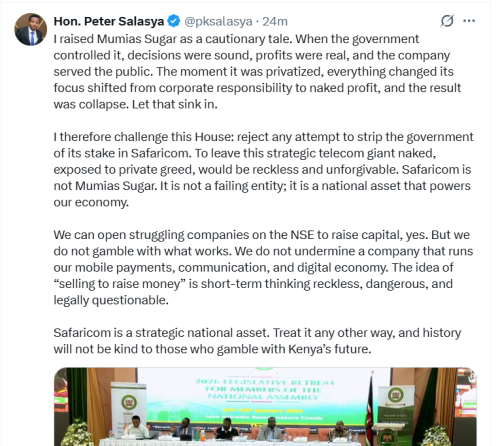
In a parliamentary speech shared on his X account on January 30, 2026, Salasya urged lawmakers to reject any plan to reduce government ownership in the telecommunications firm, describing Safaricom as a strategic national asset whose stability should not be compromised.
“I raised Mumias Sugar as a cautionary tale. When the government controlled it, decisions were sound, profits were real, and the company served the public. The moment it was privatised, everything changed, its focus shifted from corporate responsibility to naked profit, and the result was collapse. Let that sink in,” Salasya said.
He warned that diminishing the state’s stake in Safaricom would expose the company to private interests at the expense of the public good.
You Might Also Like



“I therefore challenge this House: reject any attempt to strip the government of its stake in Safaricom. To leave this strategic telecom giant naked, exposed to private greed, would be reckless and unforgivable. Safaricom is not Mumias Sugar. It is not a failing entity; it is a national asset that powers our economy,” he added.
Salasya described any proposed sale as short-sighted, arguing that Safaricom plays a central role in mobile payments, communication, and the broader digital economy.
Government privatisation agenda
The MP’s remarks come as the government advances its broader privatisation agenda. President William Ruto has urged Kenyans to participate in planned initial public offerings (IPOs) for both the Kenya Pipeline Company (KPC) and Safaricom, amid growing public debate over the strategy.
Treasury Cabinet Secretary John Mbadi has said that most proceeds from the KPC and Safaricom divestments will be channelled to the National Infrastructure Fund. He has also stated that the KPC IPO has been structured to balance local and foreign investment while maintaining strategic oversight.
“We can open struggling companies on the NSE to raise capital, yes. But we do not gamble with what works. We do not undermine a company that runs our mobile payments, communication, and digital economy,” Salasya said.
Regional talks on KPC IPO
On January 29, 2026, CS Mbadi led high-level consultations in Entebbe with Ugandan officials on KPC’s ownership structure ahead of its IPO and planned listing on the Nairobi Securities Exchange.
The Kenyan delegation included officials from the Kenya Privatisation Authority, KPC, and Director General for Public Investment and Portfolio Management Lawrence Kibet. Discussions focused on the IPO process, regional energy security, and Uganda’s stake in the shared pipeline infrastructure, which transports more than 95 per cent of Uganda’s petroleum imports.
CS Mbadi assured Ugandan leaders that Kenya recognises Uganda’s strategic interest in the pipeline and will retain regulatory oversight to safeguard national and regional interests following divestment. The KPC IPO is currently open for subscription ahead of its eventual NSE listing.
Author
Latest News

Advertisement
More on News