Salasya raises alarm over Ksh11B audit queries in Talanta Stadium scandal
By Faith Lagat, February 23, 2026Mumias East MP Peter Salasya has criticised the government following an audit report by Auditor-General Nancy Gathungu that flagged irregularities in the construction of Talanta Stadium, also referred to as Raila Odinga International Stadium.
Salasya, in a February 23, 2026, post on X, accused the government of mismanaging public resources following audit queries about the Talanta Stadium project, saying the findings confirm Kenyans’ fears about accountability in major infrastructure spending.
He said the unexplained Ksh11 billion raised concerns beyond a routine oversight, describing it as evidence of systemic failure in the handling of public funds.
Salasya added that public money belongs to citizens and should not be lost through inflated paperwork or opaque processes.
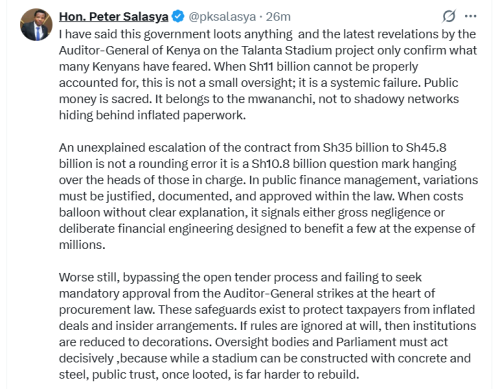
“I have said this government loots anything, and the latest revelations by the Auditor-General of Kenya on the Talanta Stadium project only confirm what many Kenyans have feared,” read Salasya’s X post.
“When Ksh11 billion cannot be properly accounted for, this is not a small oversight; it is a systemic failure. Public money is sacred. It belongs to the mwananchi, not to shadowy networks hiding behind inflated paperwork.”
Audit flags cost variation concerns
The findings emerged in the audit of the Ministry of Defence’s 2024/25 financial year accounts, raising questions over public spending and procurement processes.
The report highlights a cost escalation linked to the 60,000-seater project. The National Treasury of Kenya had approved Ksh35 billion to be financed through the Sports and Arts Social Development Fund over six years.
However, the contract signed on May 26, 2024, with a foreign contractor for design, construction, and equipping stands at Ksh45.85 billion, creating a variation of approximately Ksh10.85 billion.
The audit indicates that variations in public projects require documentation and legal approval, but no supporting records were presented to justify the increase. This has prompted concerns over whether procurement procedures were properly followed and whether oversight mechanisms were effective.
Questions over procurement process
The report also notes that the contract was awarded through direct procurement rather than open tendering as required under the Public Procurement Regulatory Authority framework and the Public Procurement and Asset Disposal Act, 2015.
Direct procurement is permitted only under specific conditions, which auditors indicated were not demonstrated.
It further states that clearance from the Attorney General for contracts exceeding Ksh5 billion was not obtained at the time. The Ministry of Sports had transferred procuring responsibility and initial funds amounting to Ksh2.01 billion to the Ministry of Defence before the award, a move that auditors said complicated oversight arrangements.
Project status and accountability calls
As of mid-2025, the project was reported to be about 44.54 per cent complete, with cumulative payments estimated at around Ksh2 billion.
The audit also warned that delayed payments could attract additional costs due to interest charges linked to the Central Bank of Kenya lending rate.
Government updates have indicated ongoing construction progress toward completion ahead of the 2027 Africa Cup of Nations.
However, the audit findings have triggered calls for further scrutiny, with Salasya urging Parliament and oversight institutions to review the matter. “Public trust, once looted, is far harder to rebuild,” he said.