Salasya blasts govt focus on profitable firms over failing parastatals
By Kenneth Mwenda, January 20, 2026Mumias East Member of Parliament Peter Salasya has criticised the Kenyan government for prioritising the sale of shares in profitable state-linked companies while ignoring struggling parastatals that continue to drain public funds.
In a series of posts on X on Tuesday, 20 January 2026, Salasya accused the government of focusing on companies that already generate strong returns, such as Safaricom and the Kenya Pipeline Company (KPC), instead of fixing or reforming failing institutions.
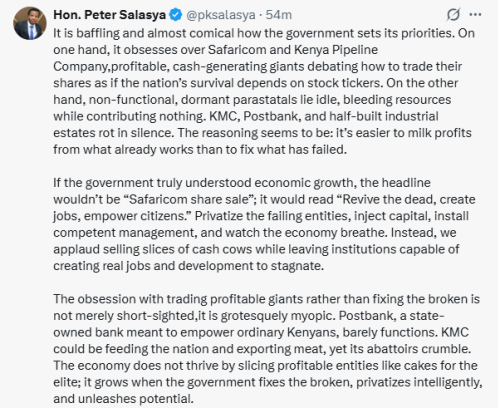
Salasya described the approach as baffling and almost comical. He argued that leaders appear more interested in profiting from successful firms than reviving dormant parastatals that could create jobs and support economic growth.
“On one hand, the government obsesses over Safaricom and KPC, profitable, cash-generating giants, debating how to trade their shares,” Salasya wrote. “On the other hand, non-functional parastatals lie idle, bleeding resources while contributing nothing.”
He singled out institutions such as the Kenya Meat Commission (KMC), Postbank and unfinished industrial estates, claiming they have been neglected despite their potential to support farmers, small businesses and ordinary citizens.
Salasya urged the government to shift its priorities. He said the country needs reforms that revive failing institutions through privatisation, capital injection and competent management, rather than repeated share sales of profitable companies.
“The economy does not grow by slicing profitable entities like cakes for the elite,” he said. “It grows when the government fixes the broken and unleashes potential.”
Asset sales
The MP described the government’s strategy as grotesquely myopic. He claimed Postbank barely functions despite its role in financial inclusion, while KMC’s facilities remain underutilised even though the commission could support food security and meat exports.
His comments came as the government pushes ahead with major asset sales to raise revenue. It plans to sell 15 per cent of its 35 per cent stake in Safaricom to Vodacom at Ksh34 per share, a move expected to raise about Ksh204 billion. Civil society groups have challenged the plan in court, citing transparency concerns.
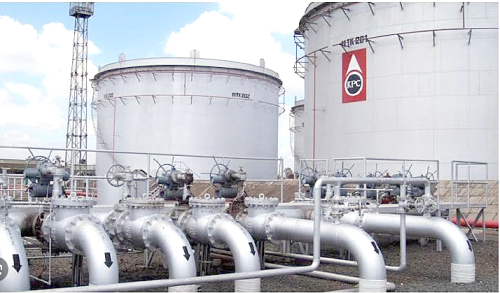
At the same time, the state launched a Ksh106 billion initial public offering for KPC on January 19, 2026. The IPO offers 65 per cent of the company’s shares at Ksh9 each and values KPC at Ksh163.6 billion. Kenyan investors will receive 60 per cent of the allocation.
Salasya also questioned Kiharu MP Ndindi Nyoro’s stance on KPC’s privatisation, accusing him of remaining silent on the issue. Earlier the same day, Salasya opposed the Safaricom share sale, calling it a “government shenanigan” and insisting the company remains a national asset.