Advertisement
Safety culture essential to successful rail transport
Monday 14th December, 2020 12:00 AM|
Olivia Mengich
The global railway system has witnessed exponential growth over the last few years.
Its market size was valued at $24.72 billion (approximately 2,6 trillion) in 2018, and is projected to reach $37.36 billion by 2026, registering a compound annual growth rate of 5.4 per cent from 2019 to 2026.
This is according to Allied Market Research- a US-based market research and advisory company.
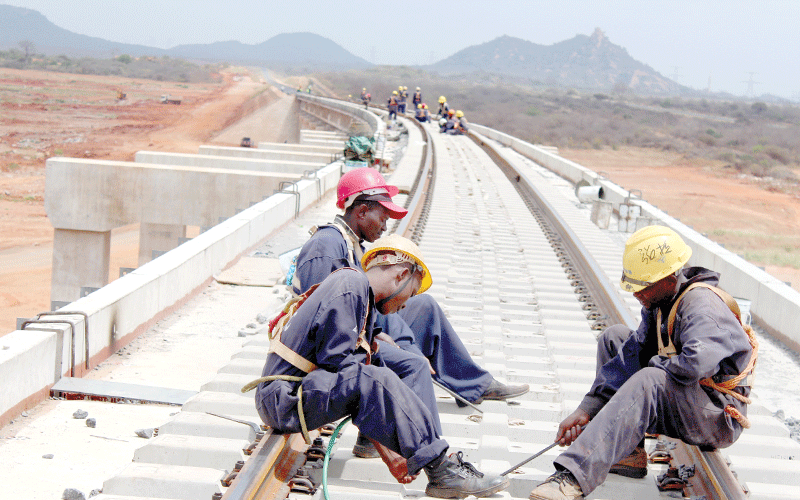
With this rapid growth, safety culture remains the essential precondition for successful rail business.
By definition, the safety culture of an organisation, is the product of individual, group values and patterns of behaviour that determine the commitment to and the proficiency of an organisation’s health and safety management.
Specifically, railway safety is concerned with the protection of life and property through regulation, management and technology development.
Outstanding safety performance means getting it right first time, fewer stoppages and delays, better operational performance and better productivity.
Conversely, unsafe working also impacts performance, both for the individual employee and for the whole railway network.
Taking cognizance of this, Africa Star Railway Operation Company (Afristar), the operator of the Standard Gauge Railway (SGR), gives precedence to safety as one of its core values. Indeed, Afristar’s mantra is “Safety First, Prevention Foremost”.
The role of safety in railway transport cannot be overstated. All railway systems and equipment have a human component and are therefore susceptible to human error.
It is worth noting that the operator and Kenya Railways Corporation (KRC) — the SGR regulator, give prominence to safety.
Notably, Afristar has inculcated a railway safety culture among staff, through evaluation of employee adherence to safety regulations and procedures, performance appraisals and rewarding safety champions quarterly and annually.
Joseph Njane, one of the training beneficiaries, is a safety officer from the Safety Supervision Department.
He trains Afristar employees on “occupational safety and health,” and has recorded railway safety training videos, that are used as one of the training materials.
From the perspective of a railway organisation, acknowledging the importance of safety implies that an integrated safety approach may be necessary to gain trust from the public and the regulator.
In such an integrated approach, the basic design of a technology should aim to simultaneously minimise the consumption of material, energy and land; environmental pollution; as well as external and occupational safety and health risks.
In addition, there is need for the railway industry to have a dynamism of safety culture, to cope with the ever-changing safety issues that emerge from a changing socio-economic environment.
To catalyse a safety culture among riders and other rail users, an animation demonstrating SGR safety tips is televised in all stations.
The safety signs are also displayed throughout the station.
Besides, passenger stewards and attendants are on hand to take passengers through safety guidelines.
This has also been extended to the community, where the safety and supervision department has conducted over 150 safety training exercises in schools, shopping centres and local government agencies along the Mombasa -Suswa line.
In the final analysis, safety culture and its dynamics cannot be considered in isolation but must be integrated with the system thinking framework. The dynamic relations between technology, human resources, management and culture must be considered simultaneously to develop an understanding of the temporal profile of safety performance and to develop analytical tools for evaluating management policy. — The writer is the Deputy Manager, Corporate Culture at Afristar
Author
People Daily
View all posts by People DailyLatest News





Advertisement
More on News