Ruto boasts of reforms in the coffee sector, raising farmers’ income
By Cynthia Lodite, April 25, 2026President William Ruto has boasted of the Kenyan coffee sector reforms, describing increased farmer payouts from an average of Ksh60 to as high as Ksh160 per kilo over three years.
In a post on his official X account on Saturday, April 25, 2026, Ruto affirmed his commitment to farmers in ensuring they earn more.
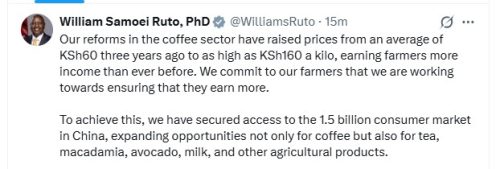
“Our reforms in the coffee sector have raised prices from an average of KSh60 three years ago to as high as KSh160 a kilo, earning farmers more income than ever before. We commit to our farmers that we are working towards ensuring that they earn more,” Ruto stated.
At the same time, Ruto has highlighted a new trade deal granting Kenyan agricultural exports, including coffee, tea, macadamia, avocado, and milk, duty-free access to China’s 1.5 billion consumer market.
“To achieve this, we have secured access to the 1.5 billion consumer market in China, expanding opportunities not only for coffee but also for tea, macadamia, avocado, milk, and other agricultural products,” Ruto added.
The Coffee Act
His remarks come months after President William Ruto signed into law reforms reshaping Kenya’s coffee industry, establishing a new Coffee Board of Kenya and shifting regulation away from the Agriculture and Food Authority.
According to Ruto, the new Coffee Act strengthens the development and regulation of the coffee industry by establishing the Coffee Board of Kenya to regulate and promote the sector.
The Coffee Act Bill, sponsored by Kigumo MP James Murango and co-sponsored by Majority Leader Kimani Ichung’wah, seeks to introduce changes intended to revive Kenya’s once-thriving coffee industry.
In addition, the new Coffee Act also creates the Coffee Research and Training Institute.
The enactment of the Coffee Act, derived from the Coffee Bill (Senate Bill No. 10 of 2023), sets in motion a broad institutional overhaul of one of the country’s most storied export industries.
Under the law, the Coffee Board of Kenya will oversee licensing across the industry, maintain national registers of coffee dealers, collect market intelligence and coordinate development strategies for the sector.
The law also introduces a new funding mechanism for the industry through a 2.5per cent Coffee Development and Marketing Levy applied to the value of coffee exports and imports.