Ruto and governors seal breakthrough deal to fix devolution bottlenecks
By Kenneth Mwenda, December 11, 2025President William Ruto and the Council of Governors have agreed on a set of firm actions to clear long-standing hurdles in Kenya’s devolved system.
The deal emerged from the 12th Ordinary Session of the National and County Governments Coordinating Summit, held on December 10, 2025 at State House.
The Summit reviewed progress from the previous session and set out new commitments aimed at improving cooperation between the two levels of government.
The meeting reaffirmed the Summit’s role as the highest platform for consultation between the national and county governments. Leaders noted that cooperation remains central to effective service delivery and the full realisation of devolution.
With this in mind, they adopted several resolutions to address delays, contested functions, funding gaps and stalled legislation.
One of the key decisions directs the Intergovernmental Relations Technical Committee (IGRTC) to speed up the unbundling and delineation of functions still under dispute.
The Commission on Revenue Allocation and the National Treasury will then verify the money tied to these functions, forming the basis for allocating funds in the 2026/27 financial year.
“IGRTC shall accelerate the finalization of unbundling and delineation of contested functions for transfer to the county governments,” the communique read.
Counties will also work with relevant agencies to secure legal ownership of the fixed and movable assets already transferred to them.
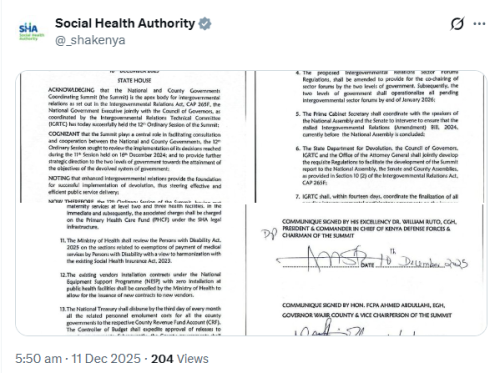
The Summit agreed to amend the Intergovernmental Relations Sector Forums Regulations to allow co-chairing by both levels of government. All pending sector forums must be operational by the end of January 2026. The Prime Cabinet Secretary will work with the Speakers of both Houses to push the stalled Intergovernmental Relations (Amendment) Bill, 2024, to conclusion.
Fresh rules and faster funding
The State Department for Devolution, the Council of Governors, IGRTC and the Attorney-General will jointly draft regulations to guide how Summit reports reach Parliament and county assemblies. IGRTC has 14 days to finalise all pending agreements on how counties issue bursaries.
Funding issues formed a major part of the resolutions. The National Treasury will fast-track disbursements for the County Aggregation and Industrial Parks and social infrastructure upgrades. It will also withdraw the Public Finance Management (Amendment) Bill to allow more consultations.
Treasury must release all county personnel emoluments by the third day of every month, while the Controller of Budget must speed up approvals. Counties must clear statutory deductions by the ninth day of each month.
The Summit approved several health-related actions. The Ministry of Health and the Council of Governors will, by mid-January, develop a framework for maternity services at level two and three facilities.
Until then, the Primary Health Care Fund will cover the associated charges under the Social Health Authority structure. The ministry will also review the Persons with Disability Act, 2025, to align medical service exemptions with the Social Health Insurance Act, 2023.
Contracts under the National Equipment Support Programme with zero installation will be cancelled and replaced with new agreements.
Community Health Promoters (CHPs) received a major boost. Their stipends will be paid on time, and they will be covered under the SHA insurance scheme on a 50-50 cost-sharing basis between both levels of government. Work will also begin on a framework to transition CHPs to permanent and pensionable terms.
President Ruto and Wajir Governor Ahmed Abdullahi signed the communique on behalf of the Summit.