Reuben Kigame sounds alarm over Nairobi high-rise boom
By Mustafa Juma, July 4, 2026Gospel musician, author and presidential aspirant Reuben Kigame has raised concerns over Nairobi’s rapid high-rise construction, questioning the source of financing behind many developments and warning that the country could face serious consequences if authorities fail to address emerging risks in the real estate sector.
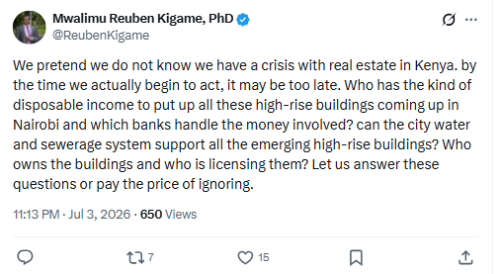
In a statement shared via his official X account on the night of Friday, July 3, 2026, Kigame said Kenya appeared to be ignoring critical questions surrounding the ownership, regulation and infrastructure capacity supporting the capital’s construction boom.
“We pretend we do not know we have a crisis with real estate in Kenya. By the time we actually begin to act, it may be too late,” Kigame stated.
Kigame further questioned who was financing the increasing number of multi-storey developments across Nairobi and whether adequate oversight existed to ensure they complied with planning and safety regulations.
“Who has the kind of disposable income to put up all these high-rise buildings coming up in Nairobi and which banks handle the money involved?” he posed.
He also challenged authorities to explain whether existing public infrastructure can sustain the city’s vertical expansion.
“Can the city water and sewerage system support all the emerging high-rise buildings? Who owns the buildings and who is licensing them? Let us answer these questions or pay the price of ignoring,” Kigame wrote on X.
Although Kigame did not cite any specific developments, his remarks come amid renewed public debate over urban planning, enforcement of building regulations and the safety of high-rise developments in Nairobi.
Building collapses reignite safety concerns
His comments follow a series of building collapse incidents that have renewed scrutiny of Kenya’s construction sector.
In April 2026, at least three people were killed and several others injured after a multi-storey building collapsed in Nairobi’s Highrise area in Kibra. Rescue teams from the Kenya Red Cross, county government and other emergency agencies mounted a search operation as authorities investigated the cause of the collapse.
Earlier in January 2026, a 16-storey building under construction collapsed in Nairobi’s South C area, trapping workers beneath the rubble and prompting a multi-agency rescue operation involving the Kenya Red Cross, police and disaster response agencies. Investigations into the incident were launched to determine what caused the structure to fail.
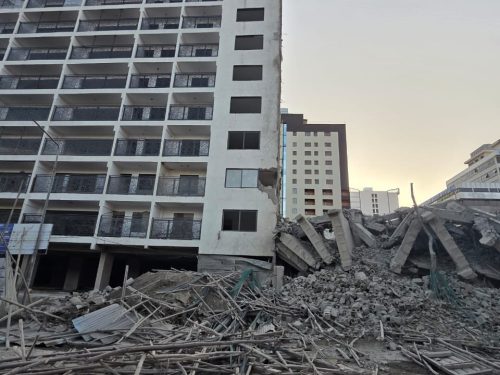
In March 2026, another tragedy occurred during the demolition of a building in Shauri Moyo, Nairobi, when the structure unexpectedly collapsed, killing at least four people and injuring several others. The incident occurred during the Nairobi River Regeneration Project and again raised concerns over enforcement of safety standards.
Longstanding problem
Building collapses have plagued Nairobi for years, often exposing weaknesses in planning approvals, construction standards and regulatory enforcement.
One of the country’s deadliest incidents occurred in 2019, when a six-storey residential building collapsed following heavy rains, killing dozens of residents. The tragedy prompted renewed calls for stricter enforcement of construction laws.
In October 2024, a seven-storey building in Kahawa West partially collapsed after structural defects were reported. Investigations later indicated that the building had allegedly been constructed and occupied without the necessary approvals, highlighting persistent concerns over illegal developments.
Following a string of fatal building collapses over the past decade, government audits have repeatedly found that many structures in Nairobi fail to meet required safety standards. After multiple collapses in 2015, the National Construction Authority found that 58 per cent of buildings inspected in Nairobi were unfit for habitation, underscoring the scale of the challenge facing regulators.