Advertisement
Parliament resumes county hearings on proposed Safaricom stake sale
Tuesday 03rd February, 2026 07:02 AM|

The National Assembly has resumed public hearings on Sessional Paper No. 3 of 2025, which proposes the partial sale of the Kenyan government’s stake in Safaricom PLC.
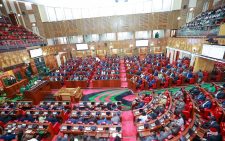
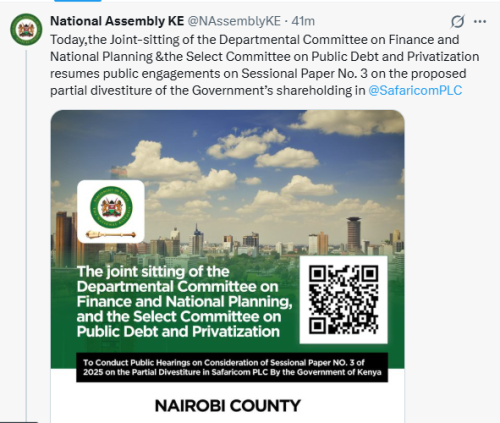
On February 3, 2026, a joint sitting of the Departmental Committee on Finance and National Planning and the Select Committee on Public Debt and Privatisation restarted public engagements in Nairobi, Mandera, Nyandarua and Machakos counties. The hearings will run until February 14, 2026 and will cover 30 counties nationwide.
The government plans to sell 15 per cent of its current 35 per cent shareholding in Safaricom. This would see the state offload about 6.01 billion shares, reducing its ownership to 20 per cent. The proposed price stands at Ksh34 per share, which would generate gross proceeds of about Ksh204 billion.
The transaction also includes an upfront payment of Ksh40.2 billion, raised through the monetisation of future dividends. This pushes total inflows higher under some projections. Vodacom is the main buyer. It already holds 40 per cent of Safaricom and would raise its effective control to about 55 per cent after acquiring Vodafone’s remaining interest.
You Might Also Like
Parliament tabled the sessional paper in December 2025 as part of efforts to raise funds without taking on new debt. Government officials say the money will support infrastructure projects, mainly through the National Infrastructure Fund.
They argue that the proposed sale price represents a premium of about 23.6 per cent over Safaricom’s six-month volume-weighted average share price up to early December 2025. Independent valuations using methods such as the Gordon Growth Model, Free Cash Flow to Equity and price-to-earnings multiples place Safaricom’s fair value between KSh 24 and KSh 37 per share. On that basis, the KSh 34 offer falls within the accepted valuation range.
Supporters of the plan also point to the cost of financing. They estimate that raising funds through this structure carries an effective annual cost of about 5.6 per cent, which is lower than Kenya’s current sovereign bond yields.
Stakeholders weigh in
The committees have already received views from key stakeholders. Safaricom chief executive officer Peter Ndegwa appeared before the joint committees in January 2026 and told MPs that the deal would not affect the company’s operations.
“There will be no transfer of operational control, no dilution of regulatory authority, and no weakening of governance standards arising from the transaction,” Ndegwa said.

He added that Safaricom would continue to support national development goals, including digital inclusion, innovation and job creation.
Other groups expressed concern. The Institute of Certified Public Accountants of Kenya (ICPAK) called for clear and transparent valuation and pricing methods. The institute warned that heavy reliance on foreign investors could increase market volatility and reduce opportunities for local participation.
Some MPs questioned how the government would protect the proceeds from misuse. They asked for clear mechanisms to ring-fence the funds for infrastructure projects. Others raised concerns about oversight, board composition, management nationality, supplier continuity and employment protections.
The public participation phase now allows ordinary Kenyans to submit their views. The committees collect feedback during county visits, while members of the public can also send opinions through a QR code shared in official announcements. The National Assembly has published the full schedule on its platforms to help residents plan attendance.
This phase follows stakeholder sessions held in January, where more than 100 organisations and individuals made submissions. The committees will review all feedback, address outstanding issues and prepare a final report for debate in the House.
Parliament will then decide whether to approve, amend or reject the sessional paper within the required timelines.
Author
Kenneth Mwenda
Kenneth Mwenda is a business, sports, and politics digital writer with over seven years of experience in journalism, covering breaking news, feature stories, and in-depth analysis across a range of beats.
For inquiries, he can be reached at [email protected]
View all posts by Kenneth MwendaLatest News



Advertisement
More on News
