Okango: Gachagua impeachment judgement will test limits of parliament’s powers
By Mustafa Juma, June 8, 2026Political analyst Fred Okango has said the High Court ruling on former Deputy President Rigathi Gachagua’s impeachment case will serve as a major constitutional test on the extent of Parliament’s impeachment powers and the role of courts in overseeing the process.
In a detailed analysis shared via his official X account on Monday, June 8, 2026, ahead of the highly anticipated judgement, Okango argued that the case is less about political rivalries and more about whether constitutional procedures and principles of fairness were properly followed during the impeachment proceedings.
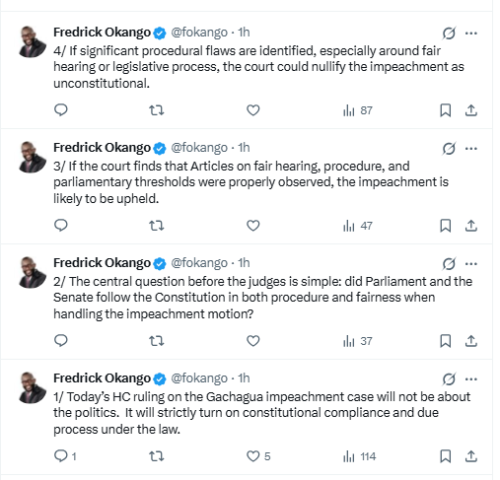
“Today’s High Court ruling on the Gachagua impeachment case will not be about the politics. It will strictly turn on constitutional compliance and due process under the law,” Okango stated.
According to him, the judges will primarily focus on whether Parliament and the Senate adhered to constitutional requirements relating to procedure, fair hearing, and legislative thresholds while handling the impeachment motion against Gachagua.
“The central question before the judges is simple: did Parliament and the Senate follow the Constitution in both procedure and fairness when handling the impeachment motion?” he posed.
Okango explained that if the court finds that constitutional standards were properly observed, then the impeachment is likely to be upheld. However, he noted that serious procedural irregularities could lead to the nullification of the process.
“If the court finds that Articles on fair hearing, procedure, and parliamentary thresholds were properly observed, the impeachment is likely to be upheld. If significant procedural flaws are identified, especially around fair hearing or legislative process, the court could nullify the impeachment as unconstitutional,” he said.
Compromise judgement
He also pointed to the possibility of a compromise judgement in which the court criticises aspects of the process without necessarily overturning the final outcome.
“A third possibility is a mixed ruling: strong criticism of the process without fully overturning the outcome, which is common in politically sensitive constitutional disputes,” he added.
Okango further noted that Kenyan courts have historically prioritised constitutional procedure over political considerations in major governance disputes.
“In Kenya’s constitutional practice, courts tend to prioritise process over political substance. The judgment will likely reflect that consistent judicial approach,” he observed.
Impeachment powers
The ruling is expected to have far-reaching implications for the relationship between Parliament and the judiciary, especially concerning how impeachment powers are exercised and reviewed under the Constitution.
Gachagua’s impeachment case has attracted intense national attention, with a section of Kenyans viewing it as one of the most consequential constitutional disputes in recent years.
Okango said the outcome of the case will shape future impeachment proceedings and define how strictly courts can scrutinise parliamentary actions.
“Whatever the outcome, today’s decision will set an important precedent on how far parliamentary impeachment powers extend—and how tightly courts will police that process,” he concluded.
Gachagua’s impeachment judgement
All eyes are now on the High Court as a three-judge bench delivers what could become one of the most politically consequential rulings in Kenya’s recent constitutional history: the judgement on the impeachment of former Deputy President Rigathi Gachagua.
Security has been beefed up at the Milimani Law Courts before the most anticipated impeachment judgement of the former Deputy President.
The judgement is expected to be delivered starting at 11:00 am at the ceremonial hall.
The ruling by Justices Eric Ogola, Anthony Mrima, and Frida Mugambi is expected to determine whether Gachagua’s dramatic 2024 ouster from office met constitutional standards or whether Parliament violated due process in removing the country’s second-highest-ranking official.
But beyond the courtroom, the judgement carries implications far larger than one politician’s legal battle. It touches on the interpretation of constitutional safeguards, the balance of power between institutions, and perhaps most importantly, the future of Mt Kenya politics ahead of the 2027 General Election.