Advertisement
ODPP unveils guidelines on how to deal with cross-border criminal networks
Friday 10th April, 2026 05:05 PM|

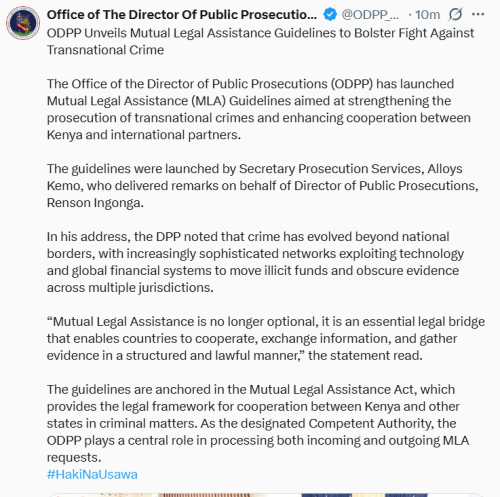
The Office of the Director of Public Prosecutions (ODPP) has launched the Mutual Legal Assistance (MLA) Guidelines aimed at strengthening Kenya’s response to transnational crime.
The framework is designed to improve international cooperation in investigations and prosecutions involving cross-border criminal networks.
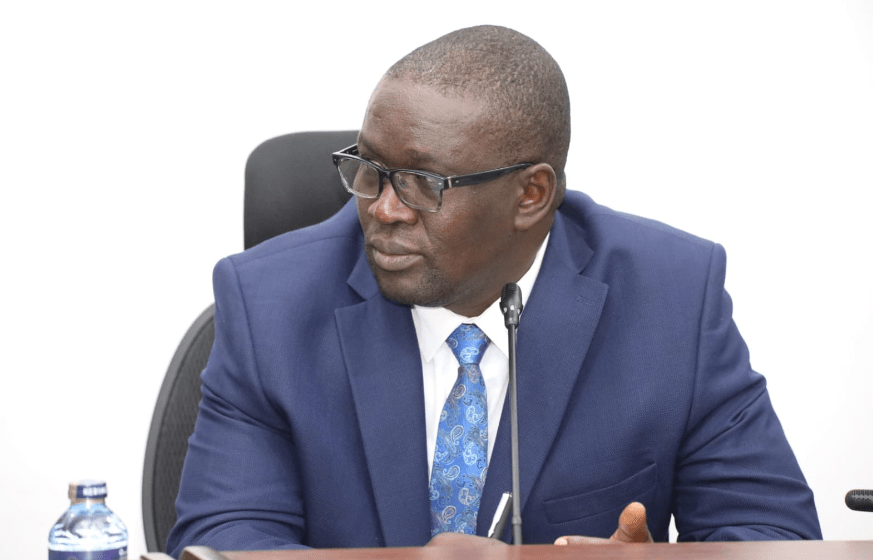
The guidelines were launched by Secretary for Prosecution Services Alloys Kemo on behalf of Director of Public Prosecutions Renson Ingonga during an official event on strengthening justice sector coordination.
According to the ODPP, modern criminal activity has increasingly become global, with offenders using technology and international financial systems to move illicit funds and conceal evidence across jurisdictions.
You Might Also Like

“Mutual Legal Assistance is no longer optional; it is an essential legal bridge that enables countries to cooperate, exchange information, and gather evidence in a structured and lawful manner,” the ODPP stated.
Framework for cross-border cooperation
The new guidelines provide a structured mechanism for handling requests for legal assistance between Kenya and foreign states in criminal matters. The ODPP is designated as the Competent Authority responsible for processing both incoming and outgoing MLA requests.
Since 2023, the office has handled at least 45 MLA requests, reflecting increasing demand for cross-border legal cooperation in complex criminal investigations.
The guidelines are anchored in the Mutual Legal Assistance Act and are intended to address delays, procedural inconsistencies, and challenges in multi-jurisdictional cases.
They also align with international standards, including recommendations from the Financial Action Task Force (FATF), particularly in relation to financial crimes and asset recovery.
Standard procedures and coordination
The guidelines introduce standardised templates, including Annex 6 for outgoing requests, to ensure consistency and completeness in documentation submitted to foreign jurisdictions.
They also set out internal procedures covering timelines, approval processes, and decision-making structures under Sections 6 and 7 of the Mutual Legal Assistance Act.
Flowcharts outlined in Annexes 2 to 5 provide step-by-step processes for transmission and handling of requests to improve efficiency and admissibility of evidence collected abroad.
The framework also clarifies coordination roles between the ODPP and the Office of the Attorney General under Section 5 of the Act, and designates official contact points for international communication.
Strengthening international prosecutions
Implementation of the guidelines will be led by the Extradition, Mutual Legal Assistance and International Cooperation (EMIC) Division, which will also conduct nationwide training for prosecutors on the new procedures.
The ODPP said the framework will enhance consistency, improve record-keeping, and strengthen cooperation with international partners in criminal justice processes.
The move comes as Kenya intensifies efforts to combat money laundering, terrorism financing, cybercrime, and other forms of organised transnational crime.
The ODPP has previously collaborated with international partners, including the United States Department of Justice, in complex prosecution cases involving cross-border elements.
Author
Latest News






Advertisement
More on News