Advertisement
ODPP rolls out guidelines to tighten grip on corruption cases
Thursday 28th August, 2025 05:14 PM|

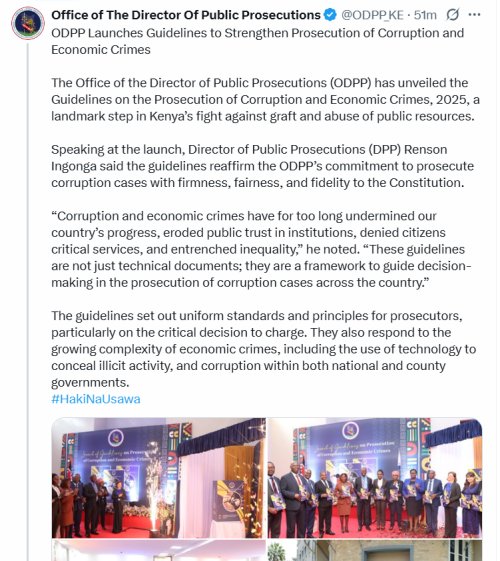
The Office of the Director of Public Prosecutions (ODPP) has unveiled new guidelines on the prosecution of corruption and economic crimes, marking a decisive step in Kenya’s battle against graft.
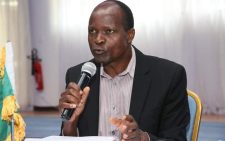
Launched at a ceremony attended by key stakeholders, the guidelines seek to strengthen prosecutorial efficiency, ensure consistency in decision-making, and address the rising sophistication of economic crimes. Director of Public Prosecutions Renson Ingonga said corruption has long undermined the country’s progress, eroded trust in institutions, and denied citizens basic services.
“These guidelines are not just technical documents; they are a framework to guide decision-making in the prosecution of corruption cases across the country,” Ingonga said.
Framework for justice
The guidelines introduce uniform standards for prosecutors, particularly in decisions to charge, while targeting corruption at both national and county levels. They also address the growing use of technology to conceal illicit activities.
You Might Also Like


Coming just a day after Katiba Day celebrations, the rollout was framed as aligning with the Constitution’s vision of integrity and justice.
Law Society of Kenya (LSK) President Faith Odhiambo welcomed the initiative, describing corruption as “the ghost in every stalled project, the shadow behind every inflated tender, the silent hand that denies a child a classroom and a patient a hospital bed.”
She said the guidelines offer clarity and courage in fighting graft, serving as a shield against selective prosecution and a weapon against impunity. However, she cautioned that success depends on thorough investigations, efficient courts, ethical lawyers, and active citizen engagement.
Calls for collaboration
Despite her praise, Odhiambo had earlier accused the ODPP and the Ethics and Anti-Corruption Commission (EACC) of indulging in “media theatrics” instead of delivering convictions and asset recovery. In a post on X on August 27, she warned that public statements without concrete action only fuel anxiety.
Ingonga, speaking earlier this month at the LSK Annual Conference, emphasised the need for stronger collaboration across institutions. He pointed to recent convictions of former governors as evidence of progress, saying they reflect a growing commitment to accountability.
Tackling backlogs
Kenya’s current listing under the Financial Action Task Force (FATF) “Grey List” for anti-money laundering weaknesses has added pressure for reforms. Ingonga said plea bargaining will be used more aggressively to cut down case backlogs, noting similar approaches have reduced delays by up to 30 per cent elsewhere.
He urged lawyers to play their role in safeguarding constitutionalism, insisting that the fight against corruption can only be won through united professional efforts.
Author
Latest News




Advertisement
More on News