Oburu calls for proactive planning to tackle deadly floods
By Faith Lagat, March 20, 2026Siaya Senator and the Orange Democratic Movement (ODM) party leader Oburu Oginga has questioned why annual floods in Kisumu continue to be treated as emergencies instead of being anticipated and mitigated.
Speaking during the Idd-ul-Fitr Luncheon hosted by President William Ruto at Kisumu State Lodge on March 20, 2026, Oburu highlighted the predictable nature of the disasters.
“Every year in Kisumu, floods wreck havoc in Migori, Samia and when the floods happen, they are treated as emergency but how can something well known – that floods will come at a certain point and you don’t plan for them, no fund to mitigate it, and you call it emergency, this should come to an end,” he stated.
Recurring floods and impact
Oburu’s remarks come amid heavy seasonal rains that have caused widespread flooding across Kenya since early March 2026.
The downpours have resulted in more than 70 deaths, with major disruptions in Nairobi, where rivers like the Nairobi and Ngong overflowed, affecting areas such as Parklands, CBD, Kibera, Kilimani, Kawangware, and Eastleigh. Other counties impacted include Kisumu, Migori, Siaya, and Busia.
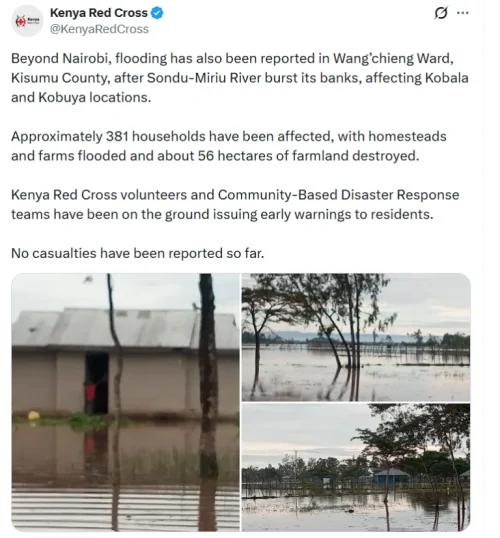
In Kisumu County, the Sondu-Miriu River overflowed, displacing hundreds of residents in Wang’chieng Ward and submerging homes in Kobala and Kobuya locations.
Around 56 hectares of farmland were destroyed, threatening local food security, while timely evacuations by volunteers and Community-Based Disaster Response teams helped prevent casualties and highlighted the importance of early preparedness.
Urban areas have also faced severe disruptions, with Nairobi streets transforming into rivers as heavy rains affected major roads, including Uhuru Highway, Mombasa Road, Thika Superhighway, Jogoo Road, and Lang’ata Road.
Residents in neighbourhoods such as Pipeline, Embakasi, Mukuru, Kibra, Mathare, and South C experienced long delays, while rescue teams saved at least 20 people along Kirinyaga Road.
The Kenya Red Cross has issued safety guidelines, urging people to evacuate to higher ground, avoid driving near rivers, switch off electricity in flooded homes, and call the emergency line 1199 for assistance.
The Kenya Red Cross has reported rescuing people from stranded vehicles and homes, while traffic congestion has affected major routes, including the Nairobi Expressway and Limuru Road. Experts say poor drainage, inadequate infrastructure, and unplanned urban development have worsened the effects of the predictable rains.
Call for long-term solutions
Oburu stressed that labelling recurring floods as emergencies allows for reactive responses instead of investing in prevention.
He called for dedicated funds for flood management, improved drainage systems, construction of dams, and resilient infrastructure in vulnerable areas.
President Ruto, who attended the luncheon, assured Kenyans of government support, noting multi-agency teams were conducting rescues, evacuations, and distribution of aid, including food and medical supplies.
He urged citizens to follow the Kenya Meteorological Department advisories and emphasised collaboration between national and county governments.
During the event, Oburu also praised Ruto for establishing the National Infrastructure Fund (NIF), describing it as a model that could finance major projects without heavy borrowing.
The fund aims to support infrastructure development, including roads, railways, dams, and energy projects measures that could indirectly reduce flood risks.