Advertisement
NTSA gives step by step guide on re-registration of civilian vehicles
Tuesday 27th January, 2026 03:05 PM|

The National Transport and Safety Authority (NTSA) has issued an advisory to motorists, outlining the process and requirements for the re-registration of civilian Vehicles.
In an update on Tuesday on their social media handles on January 27, 2026, the authority announced that the re-registration process is conducted entirely online through its portal, which is accessible through the eCitizen website.
“Applying to re-register a civilian vehicle? Ensure you have the following documents,” NTSA stated.
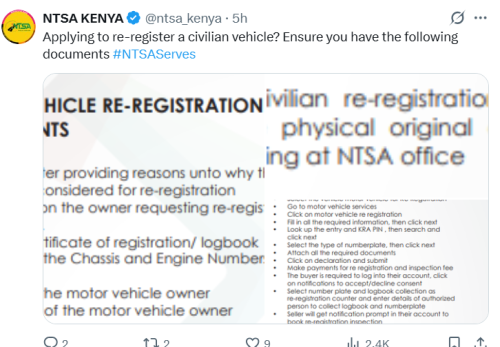
The re-registration applies to vehicle owners seeking changes such as number plate replacement, ownership updates, or other approved re-registration reasons. Civilian vehicle re-registration is important for the official transfer of ownership of a vehicle from the seller to the buyer to avoid legal and financial implications.
You Might Also Like


The Process explained
To kickstart the process, a vehicle owner is supposed to log in to the NTSA portal, navigate to the ‘Motor Vehicle Services’ section, select the option for vehicle re-registration and enter the required vehicle details, including KRA PIN, to allow the system to retrieve and verify the vehicle information.
Once the vehicle details are verified, the applicant then selects the preferred type of number plate and uploads all the necessary supporting documents, such as logbook, ID card and KRA PIN certificate.
After confirming the declaration, the application is submitted, and the re-registration and inspection fees are paid online through the portal.
In a case where ownership transfer is involved, the buyer is required to log in to their NTSA account to accept or decline the consent notification.
The applicant then selects the preferred collection centre for the new number plate and logbook and indicates whether an authorised person will collect the documents on their behalf.
Following submission, the seller receives a notification prompting them to book a vehicle inspection. The inspection is scheduled by selecting a convenient inspection centre and date.
After a successful inspection, the applicant is required to submit the original physical documents for verification. NTSA then reviews the application and, upon approval, allocates a new number plate.
Requirements for Civilian Vehicle Re-Registration
NTSA has outlined the documents required to support the application, including a formal request letter detailing the reason for re-registration.
Other requirements are a report from the DCI confirming the owner’s request for re-registration and an original certificate of registration.
The applicant also requires a tape lift of the chassis and engine numbers from the DCI, a KRA PIN certificate of the vehicle owner and a copy of the National ID of the vehicle owner.
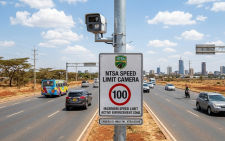
The highlighting of the process comes as the country gears towards full enforcement of instant traffic fines. Besides fines, NTSA is also contemplating mounting speed cameras in an effort to reduce road accidents and easily apprehend the offenders.
Author
Latest News








Advertisement
More on News