Advertisement
New research to improve life skills among leaners
Friday 04th March, 2022 12:09 AM|
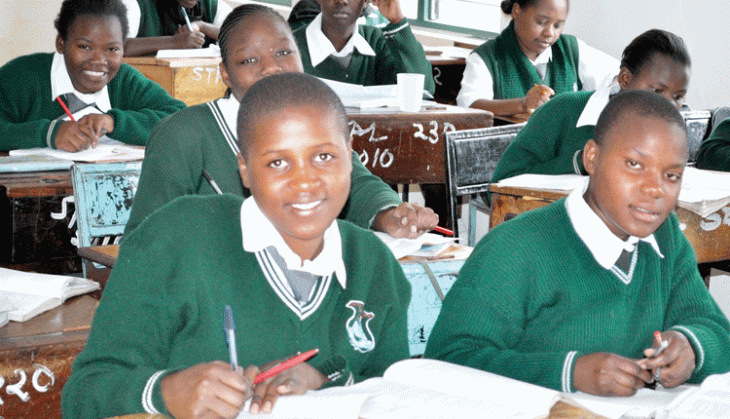
A new research by Zizi Afrique Foundation, a local non-governmental organization in collaboration with other 20 Civil Society Organizations who have committed to undertake the Assessment of Life Skills and Values in East Africa (ALiVE).
The five-year project was initiated two years ago with the aim to measure competencies among school going children in East Africa within the age group of 13-17 years.
According to Dr John Mugo, Executive Director of the Zizi Afrique Foundation “In Kenya the pilot research is taking place in Tharaka Nithi County with the aim of assessing the life skills in 400 households within the county. In April, we will then conduct the National Assessment in 20 counties in Kenya.
If we have committed to develop these competences in our children, we must be able to also assess them. How else will we know if we are achieving this? We must have a way of telling how much our children can solve problems, or collaborate, because this will determine their success in the many spheres of life”.
The research is being undertaken in Tanzania, Kenya and Uganda has two phases. Presently in its first phase targeting 10,000 households in Kenya expected to end in 2023.
We are working with a team from the Ministry of Education, KICD, Regional Education Learning Initiative (RELI), Kenyatta University and Kenya National Theatre. All these parties were put together as a way of ensuring that the research findings are 99 percent accurate,” says Purity Ngina, Evidence Manager, Zizi Afrique.
She added that despite the new Competency Based Curriculum being implemented in the country. There are still huge life skills gap among school going children.
“It’s the desire of the government that CBC will bridge the skill gap we need for economic development but again you find that 99 per cent of the school going children still lack the ability to solve societal problems then we need to ask ourselves the hard questions. This is why we are carrying out this research with the aim of coming up with our own tools that we can use to assess the level of life skills among our own children.”
The second phase is expected to commence in April this year and ends in 2025.
“In this phase we shall be targeting the age group between 6-12 years and mainly. Our plan is to reach 16,000 households in 20 counties across the country.”
Dr Esther Care, Professor from University of Melbourne who is part of the team of researchers believes that Africa should create its own life skills assessment tools based on their findings. She also pointed out that the tool once fully developed will help the Ministry of Education in Kenya to monitor the progress of its new CBC.
“The new curriculum is ideal for Kenyans however we need to effectively monitor its impact on the school going children and in order to do so we need an assessment tool that will enable households to monitor their children’s ability to solve problems at home as a way of learning hence this will help in creating a harmonious society,” she quips.
Author
Steve Umidha
View all posts by Steve UmidhaLatest News







Advertisement
More on News