National Assembly invites public views on Finance Bill 2026
By Ndiritu Wanjiru, June 1, 2026In preparation for Finance Bill 2026, the National Assembly has called on Kenyans to attend public hearings of three key bills, which, if passed into law, will dramatically change the fiscal management, financial governance, and revenue administration landscape of the country.
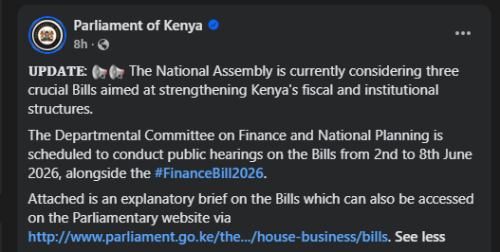
Taking it to their social media on Sunday, May 31, 2026, the Parliament of Kenya has noted that there will be public participation sessions in the Departmental Committee on Finance and National Planning on the proposed legislation from June 2 to June 8, 2026, along with public hearings on the Finance Bill 2026.
Parliament has also stated that the exercise will collect public views that will guide amendments before the second reading stage of the bills.
“The National Assembly is currently considering three crucial bills aimed at strengthening Kenya’s fiscal and institutional structures. The Departmental Committee on Finance and National Planning is scheduled to conduct public hearings on the bills from 2nd to 8th June 2026, alongside the #FinanceBill2026,” Parliament noted in a statement.
According to the National Assembly, the three proposed laws are the Sovereign Wealth Fund Bill, 2026; the Central Bank (Amendment) Bill, 2026; and the Kenya Revenue Authority (Amendment) Bill, 2026. The National Assembly says the law will make Kenya more economically resilient, increase accountability in public institutions, and manage public resources.
Sovereign Wealth Fund
One of the proposals being discussed is the Sovereign Wealth Fund Bill, 2026, which aims to create a national fund to ensure long-term fiscal sustainability and to provide benefits to both current and future generations from natural resources.
The bill would establish three aspects of the fund: a Stabilisation Fund to buffer the economy from financial shocks; a Strategic Infrastructure Investment Fund to fund priority development projects; and a Future Generations Fund to allow long-term savings to be made from revenues arising from petroleum and mineral resources.
The proposed sovereign wealth fund will be funded with petroleum and mining revenues, petroleum and mineral rights grantings and assignments, and other natural resource values approved by the legislature. The fund will be administered by a dedicated board and subject to the Auditor-General’s audit.
CBK and KRA Reforms
The Central Bank (Amendment) Bill, 2026, aims to further build the legal framework for liquidity support by the Central Bank of Kenya. The proposed legislation is intended to separate out the normal monetary policy operations from emergency financial aid to institutions in need of liquidity assistance.
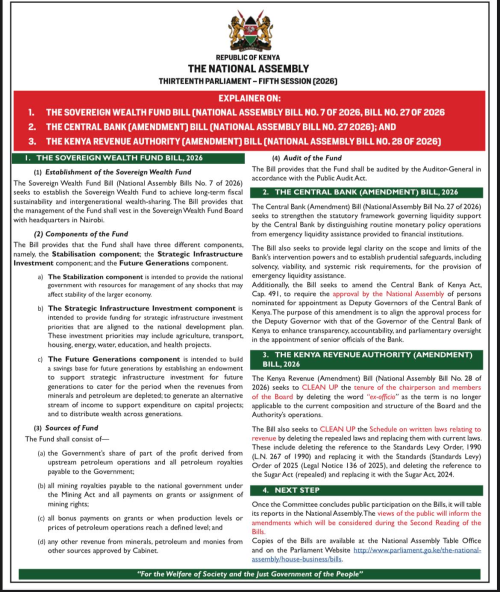
One of the major recommendations in the bill is that approvals of nominations of deputy governors of the Central Bank of Kenya to serve on the bank should be based on the National Assembly. This is said to increase transparency, accountability and parliamentary oversight.
In the meantime, the Kenya Revenue Authority (Amendment) Bill, 2026, aims to modernise governance within the tax authority, including by introducing modern provisions on the tenure of Kenya Revenue Authority (KRA) board members and removing obsolete references in tax legislation. The amendments would sync KRA’s legal framework with existing laws and administration.
The National Assembly has asked the general public, stakeholders and interest groups to consult on the Bills and provide their feedback in the public consultation period. Parliament, however, pointed out that the opinion of the public is an important part of the legislative process and will be crucial in shaping the final form of the proposed legislation.
The Bills and explanatory documents have been placed on Parliament’s official system of publication so that they can be read to allow informed contributions by the public.