Advertisement
Murkomen: Majority of Osotsi attackers fled the country
Tuesday 21st April, 2026 03:01 PM|

Interior Cabinet Secretary Kipchumba Murkomen has said some persons of interest linked to the assault on Vihiga Senator Godfrey Osotsi in Kisumu fled to a neighbouring country as security agencies step up efforts to track them down.
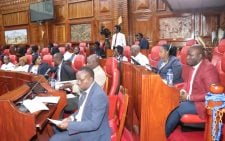
Speaking before the Committee on Administration and Internal Security in Parliament on Tuesday, April 21, 2026, Murkomen said investigators had already identified several persons of interest after images were circulated by the Directorate of Criminal Investigations (DCI).
“The DCI circulated the pictures. As you said, some of them presented themselves. Three of them presented themselves,” he told the committee.
He added that a larger group of persons of interest escaped Kenya shortly after the incident.
You Might Also Like



“The rest of the 13 or 14 ran out of the country to the neighbouring country,” Murkomen said.
According to the CS, Kenyan authorities are now working with security agencies across the border to pursue them. He said arrests will be made once they return.
“The IG and the DCI are with them, working with the authorities in the neighbouring country. And we will arrest all of them eventually,” he said. “As soon as they step in in this country, they will all be arrested,” the CS insisted.
Sending a strong message
CS Murkomen said the government intends to use the case to send a strong message against political violence.
“I hope that will be the first example to show that violence doesn’t pay,” he maintained.
The remarks come days after Osotsi narrated how he was attacked in Kisumu by a group of youths while at a barber shop. The senator said the group approached him while shouting his name before turning violent and beating him unconscious.
He linked the attack to his political stance, saying the assailants questioned his position on President William Ruto’s leadership.

Policing rallies remains difficult
Murkomen used the incident to highlight what he described as a growing challenge in policing political gatherings. He said it is often difficult to separate ordinary supporters from individuals who later engage in violence.
“There’s a thin line between a criminal and political supporters,” he said. “Political supporters who are criminals when they are committing crime and when they are just present as physical supporters.”
He told lawmakers that politicians cannot always guarantee the conduct of crowds they mobilise for rallies.
“Can you for sure tell this House that you will not mobilise criminals to accompany you to the rally? You cannot say with certainty,” he said.
Murkomen noted that supporters often travel from different regions, making it hard for security agencies to act before any offence is committed.
“Before they commit a crime, you cannot say I arrest them preemptively,” he said.

He also warned that some individuals arrive at events unarmed but are later supplied with weapons at the scene, escalating tensions.
“Sometimes they come empty-handed. Reaching there, somebody supplies rungus and so forth,” he said.
The CS maintained that policing alone cannot fully address the problem, especially during large political events where rival groups converge.
“This issue can only be sorted not by the police,” he said, pointing to the large numbers expected at rallies and the presence of opposing sides.
The case has added to growing concern over political violence as the country moves closer to the next election cycle, with pressure mounting on authorities to contain organised attacks linked to political activity.
Author
Kenneth Mwenda
Kenneth Mwenda is a business, sports, and politics digital writer with over seven years of experience in journalism, covering breaking news, feature stories, and in-depth analysis across a range of beats.
For inquiries, he can be reached at [email protected]
View all posts by Kenneth MwendaLatest News








Advertisement
More on News