Advertisement
Mudavadi urges boda boda riders to grab advertised chiefs’ positions
Friday 15th August, 2025 05:45 PM|

Prime Cabinet Secretary Musalia Mudavadi has urged boda boda riders to apply for positions of chiefs and assistant chiefs in their respective areas.
Speaking during an empowerment drive in Malava constituency on Friday, August 15, 2025, Mudavadi said that the boda boda riders had some of the most educated Kenyans.
He observed that some people in the industry had resorted to the job due to the limited opportunities in the country, and that they could deliver well as administrators.
Educated people
“To the boda boda operators, I know that there are very educated people amongst you; but because of challenges, maybe certain opportunities will come up as you do this job,” Mudavadi said.
You Might Also Like



“Right now, we have announced applications for chiefs and assistant chiefs. You should apply because you have the right, you have the qualifications, and are capable,” he added.
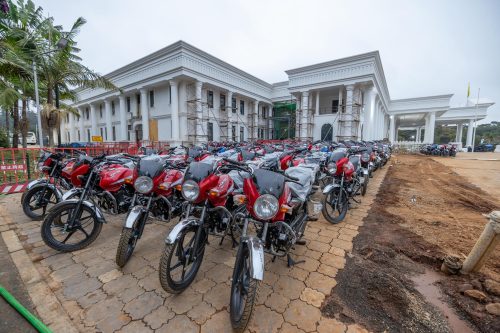
“If a boda boda rider gets an opportunity, that would be great because I know they are capable.”
While the appointment of Chiefs and Assistant Chiefs is guided by the Revised Scheme of Service for National Government Administrative Officers (October 2015), which explicitly sets the minimum qualifications, in April 2025, Interior Cabinet Secretary Kipchumba Murkomen said that marginalized areas could be exempted from the educational requirements of these roles.
An Assistant Chief II must be at least 30 years old, a resident of the sublocation, possess a police clearance certificate, be proficient in computer applications, and have a Kenya Certificate of Secondary Education (KCSE) mean grade of C-(Minus) or its equivalent from an accredited examining body.
Boda boda industry
Similarly, a chief must be at least 35 years old, have earned a C plain in the KCSE, and hold a certificate from an accredited institution in public administration, management, social work, community development, education, governance, or conflict management, or its equivalent.

The boda boda industry in Kenya has emerged as a crucial alternative source of income for millions of unemployed youths.
Faced with a scarcity of formal job opportunities, many young Kenyans are turning to motorcycle taxi services, a sector that has grown exponentially.
A recent World Bank report states the sector employs over 1.5 million people and contributes an estimated Ksh202 billion to the economy annually.
Author
Arnold Ngure
View all posts by Arnold NgureLatest News








Advertisement
More on News