MPs raise concerns over strict sentencing under Sexual Offences Act
By Ndiritu Wanjiru, May 5, 2026The Sexual Offences Act No. 3 of 2006 in Kenya is facing intense scrutiny, with new concerns emerging that the strict sentencing provisions in the Sexual Offences Act No. 3 of 2006 are driving the overcrowding of prisons in Kenya and that such sentencing procedures are causing a disproportionate impact on young men in Kenya.
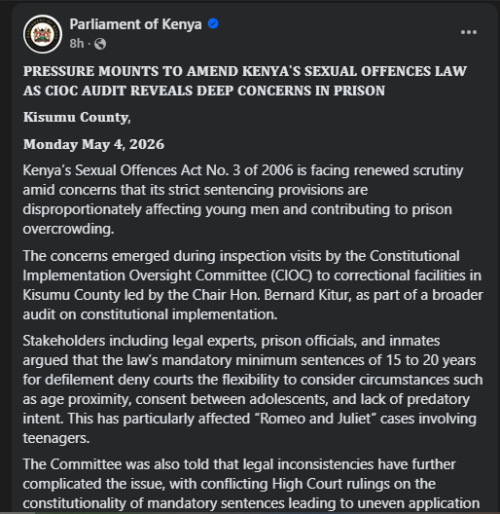
Taking it to their social media handles on Monday, May 4, 2026, the parliament noted that the issues were highlighted during inspection visits by the Constitutional Implementation Oversight Committee (CIOC), chaired by Bernard Kitur, to correctional facilities in Kisumu County. The parliament confirmed that the visit was a continuation of an audit that had been conducted on the implementation of the constitution.
“Kenya’s Sexual Offences Act No. 3 of 2006 is facing renewed scrutiny amid concerns that its strict sentencing provisions are disproportionately affecting young men and contributing to prison overcrowding,” the Parliament statement read in part.
Compulsory sentences cause concern
Stakeholders, such as legal experts, prison officials, and inmates, sounded the alarm bells over a mandatory minimum of between 15 and 20 years of imprisonment for defilement, as it denies the courts the liberty to consider critical factors such as age proximity, adolescent consent, and lack of criminal intent.
Of special interest is that of Romeo and Juliet, where minors in consensual relationships find themselves facing lengthy jail sentences under a law that was originally meant to target adult criminals.
It was also informed to the committee that conflicting decisions on the constitutionality of mandatory sentencing by the High Court have led to legal uncertainty, which has resulted in uneven application of the law in various courts.
The lawmakers also cited discrimination against the boy child by highlighting that male teenagers are often charged and incarcerated, whereas their female counterparts are never prosecuted or imprisoned.
Sex crime fuelling prison overcrowding
Statistics which were given to the committee demonstrate that over 31 per cent of the prison population comprises sexual offenders, with defilement cases constituting 78.3 per cent (including many cases of young men).
CIOC Chairman Bernard Kitur requested that the necessary reforms include the abolishment of mandatory minimum sentences in order to facilitate fair and personalised verdicts. Kitur further noted that this Act has been leading to the wastage of our men, especially the youth in our jails, and there is a need to review this Act, and I will champion this agenda to save the boy child.
“A lot of our men, especially the youth, are wasting away in jail because of this Act. There is a need for review, and I will champion this agenda to save the ‘boy child’. ” Kitur said, adding that there is a need for review.
Prisoners pressure reforms to broaden
Those inmates who came before the committee presented a memorandum which demanded more than what the law provides. They suggested reintegration by providing access to jobs, increasing vocational training programmes, improving healthcare, creating more education opportunities and reintegrating through more use of non-custodial sentences.

They also demanded that appeals should be handled more quickly, the legal aid systems reinforced, and the old laws of the prison revamped.
The call to Parliament is now mounting up to review the Act in a manner that is not only protective to the victims but also fair, proportional and just to all.