Advertisement
MPs demand review of NTSA smart licence deal
Friday 10th April, 2026 09:51 AM|

A parliamentary committee has called for an urgent review of a controversial 21-year Public-Private Partnership (PPP) deal between the National Transport and Safety Authority (NTSA) and a private consortium, warning that the agreement heavily disadvantages the public.
The National Assembly’s Public Debt and Privatisation Committee, chaired by Abdi Shurie, sharply criticised the revenue-sharing framework of the deal, terming it “grossly unfair” and skewed in favour of private investors.
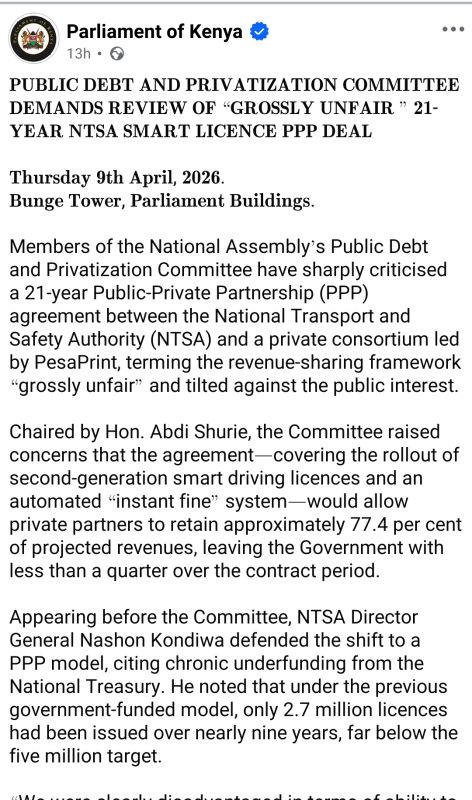
The committee, chaired by Balambala MP Abdi Shurie, raised alarm over the structure of the agreement, which focuses on the rollout of smart driving licences and an automated ‘instant fine’ system.
Who wins more in the deal?
Legislators noted that the deal would see private partners take about 77.4 per cent of the projected earnings, leaving the government with less than 25 per cent throughout the contract period.
You Might Also Like

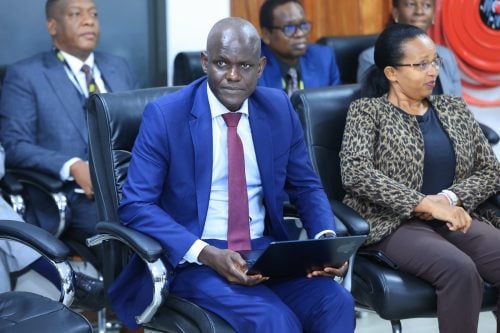
Appearing before the committee at Bunge Towers on Thursday, April 9, 2026, NTSA Director General Nashon Kondiwa defended the PPP model, citing years of underfunding from the National Treasury.
He said the authority had struggled to meet targets under a fully government-funded system, issuing only 2.7 million licences in nearly nine years against a target of five million.
/X
“We were clearly disadvantaged in terms of ability to negotiate because we are not even negotiating our own money; we are negotiating our services, and the revenue is going elsewhere,” Kondiwa stated.
He added that 60 per cent of NTSA’s revenue is surrendered to the Exchequer, a situation he said limits the authority’s ability to reinvest in key road safety initiatives.
Previous model
Despite this explanation, MPs rejected the rationale, highlighting the strong financial performance of the previous model.
Between 2017 and 2024, the government invested Ksh1.2 billion and realised Ksh6.7 billion in returns – figures lawmakers said prove that a fully public system is sustainable.
Committee member Aden Daudi questioned the financial projections underpinning the deal, arguing that they disproportionately favour private investors.
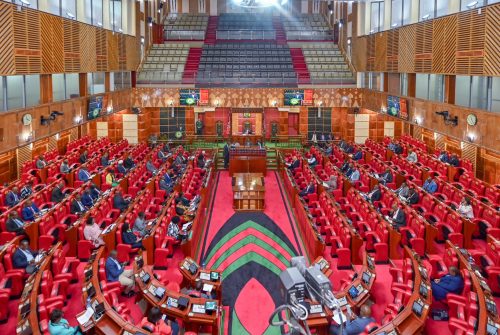
“This is a PPP that is so unfair to the public and so fair to the private part of the equation. Over 21 years, projected revenues are about KSh900 billion against costs of KSh300 billion, that is a 300 per cent profit,” he said.
Inside the deal
The consortium backing the deal includes KCB Bank, following its acquisition of the National Bank of Kenya.
The lawmakers argued that the technology required for smart licence production is comparable to that used in national ID issuance, which is managed under a traditional public model.
The project also proposes installation of 1,000 surveillance cameras nationwide to automate traffic enforcement.
While legislators acknowledged the urgent need to curb road carnage, estimated to cost the economy KSh460 billion annually, they questioned the proportionality of the deal.
“Who in their right mind negotiates away revenue from the Kenyan public? Seventy-seven per cent going to a private entity for 21 years makes no sense,” MP Daudi added.
The committee has since resolved to obtain the final agreement and summon the PPP Unit at the Treasury to explain why competitive procurement procedures may have been bypassed.
Author
Emmanuel Rono
Rono is a dynamic digital journalist with a proven track record in newsroom leadership and content creation. Currently a Digital Writer for People Daily Digital, Emmanuel’s career is rooted in a lifelong passion for storytelling.
View all posts by Emmanuel RonoLatest News





Advertisement
More on News