Morara Kebaso blasts tribal voting, warns supporting leaders by tribe is national foolishness
By Kiprono Keileb, December 9, 2025Political commentator Morara Kebaso has ignited a fresh debate on Kenya’s long-running struggle with tribal politics after issuing a strongly worded message urging voters to abandon ethnic-based decision-making ahead of future elections.
In a statement shared on X on Tuesday, December 9, 2025, Kebaso criticised Kenyans who choose leaders solely because they share an ethnic identity, warning that the practice continues to undermine accountability, national progress and personal wellbeing.

He argued that tribal voting traps citizens in cycles of poor leadership, likening it to placing loyalty above rational decision-making even when the consequences are harmful.
“Voting for someone just because he is from your tribe is the most foolish thing you can do. It’s like employing a relative in your business, and when they steal everything, including the stock you bought with a loan, you cannot arrest them or recover it because huyu ni kijana ya sister yangu, huyu ni ndugu yangu, mama ni mmoja na baba ni mmoja. In the end, you are the one who is left poor with a loan to pay,” he wrote.
Kebaso used vivid and blunt examples to illustrate how blind loyalty often leads voters to tolerate corruption or incompetence simply because the leader belongs to their community. He argued that such choices ultimately harm the very people making them.
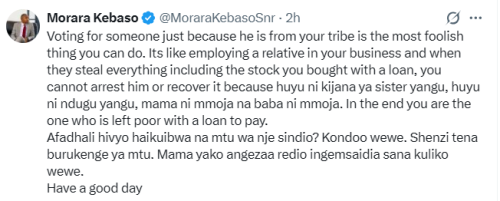
“Afadhali hivyo haikuibwa na mtu wa nje, sindio? Kondoo wewe. Shenzi tena burukenge ya mtu. Mama yako angezaa redio ingemsaidia sana kuliko wewe. Have a good day,” Morara Kebaso stated.
Morara Kebaso argues that tribal voting weakens institutions, rewards political loyalty over competence, and leaves voters vulnerable to manipulation by elites who exploit communal fears.
Kebaso’s remarks come at a time when political realignments are already underway ahead of 2027, as issues such as the economy, governance and youth unemployment may take centre stage, though tribal dynamics remain deeply influential in many regions.