Advertisement
Monica Juma warns of Haiti crime crisis ahead of UN Security Council briefing
Saturday 18th July, 2026 06:35 PM|
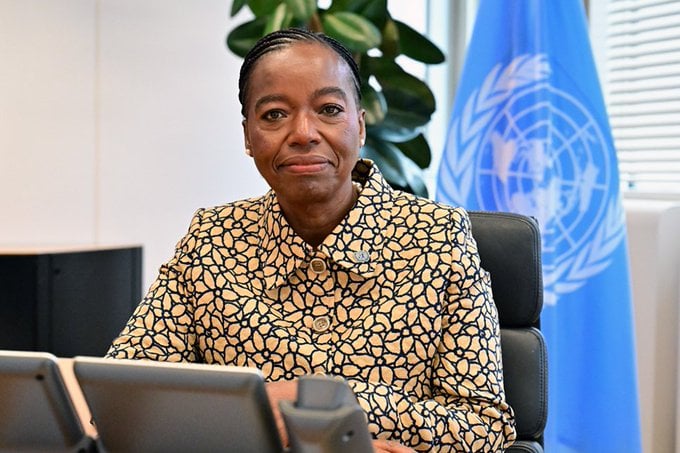
United Nations Office on Drugs and Crime (UNODC) Executive Director Monica Juma has called for stronger international support to help Haiti confront a worsening security crisis driven by armed gangs and transnational organised crime.
Juma made the remarks on Saturday July 18, 2026, after visiting Haiti and the Dominican Republic ahead of presenting the 11th UNODC report on Haiti to the United Nations Security Council in New York on Monday, July 20, 2026.
The report is being delivered under Security Council resolutions 2692, 2743 and 2785, which mandate continued monitoring of the security situation in Haiti and the impact of organised crime networks.
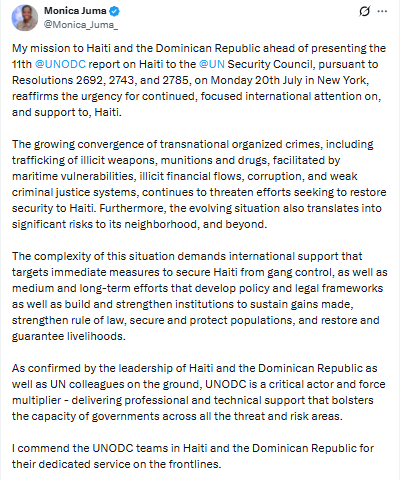
“My mission to Haiti and the Dominican Republic ahead of presenting the 11th UNODC report on Haiti to the UN Security Council reaffirms the urgency for continued, focused international attention on, and support to, Haiti,” Juma said in a post on X.
You Might Also Like
She warned that Haiti’s crisis has become more complex as criminal networks expand their activities beyond gang violence.
According to Juma, the country is facing a growing combination of threats, including the trafficking of illicit weapons, ammunition and drugs, corruption, illegal financial flows and weaknesses within the criminal justice system.
“The growing convergence of transnational organised crimes, including trafficking of illicit weapons, munitions and drugs, facilitated by maritime vulnerabilities, illicit financial flows, corruption, and weak criminal justice systems, continues to threaten efforts seeking to restore security to Haiti,” she said.
“Furthermore, the evolving situation also translates into significant risks to its neighborhood, and beyond.”
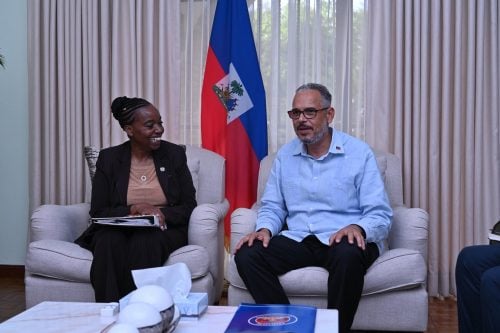
Haiti insecurity spilling over to neighbouring countries
Juma added that the instability in Haiti also poses risks to neighbouring countries and the wider region, as criminal groups exploit weak controls and international networks to expand their operations.
The UNODC chief said addressing the crisis requires both immediate security measures and long-term institution building.
“The complexity of this situation demands international support that targets immediate measures to secure Haiti from gang control, as well as medium and long-term efforts,” she said.
She called for stronger legal and policy frameworks, improved institutions, protection of communities and efforts to restore livelihoods.
Juma also highlighted the role of UNODC in supporting governments dealing with organised crime, corruption and other security threats.
“As confirmed by the leadership of Haiti and the Dominican Republic as well as UN colleagues on the ground, UNODC is a critical actor and force multiplier,” she said.
The agency provides technical support to governments in areas including crime prevention, drug trafficking, corruption and strengthening justice systems.
She praised UNODC teams working in Haiti and the Dominican Republic for their efforts in difficult conditions.
“I commend the UNODC teams in Haiti and the Dominican Republic for their dedicated service on the frontlines,” Juma said.
Haiti’s worsening security crisis
Haiti has struggled with increasing gang violence, political instability and humanitarian challenges in recent years.
Armed groups have seized control of large parts of the capital, Port-au-Prince, disrupting transport, businesses and access to essential services. Thousands of people have been forced to flee their homes due to violence.
The international community has supported efforts to strengthen Haiti’s security institutions, including the Kenya-led Multinational Security Support (MSS) Mission, which was deployed in 2024 following a UN Security Council decision.
Kenya became the leading contributor to the mission, sending police officers to support the Haitian National Police in tackling heavily armed gangs.
The mission has faced major challenges, including limited resources, insecurity and difficulties in expanding operations across areas controlled by criminal groups.
Juma brings extensive security and diplomatic experience to her UN role. Before joining the United Nations, she served as Kenya’s National Security Adviser and held Cabinet positions in Defence, Foreign Affairs and Energy.
She assumed office as UNODC Executive Director and Director-General of the UN Office at Vienna in May 2026 after her appointment by UN Secretary-General António Guterres.
Her Security Council briefing comes as international partners continue discussions on how to restore stability in Haiti while strengthening institutions capable of maintaining long-term security.
Juma’s message ahead of the meeting is that Haiti’s crisis requires more than short-term interventions. She argues that defeating criminal networks will depend on cutting off their sources of funding and weapons while rebuilding the country’s justice and security systems.
Author
Kenneth Mwenda
Kenneth Mwenda is a business, sports, and politics digital writer with over seven years of experience in journalism, covering breaking news, feature stories, and in-depth analysis across a range of beats.
For inquiries, he can be reached at [email protected]
View all posts by Kenneth MwendaLatest News



Advertisement
More on News